The Scale of the War
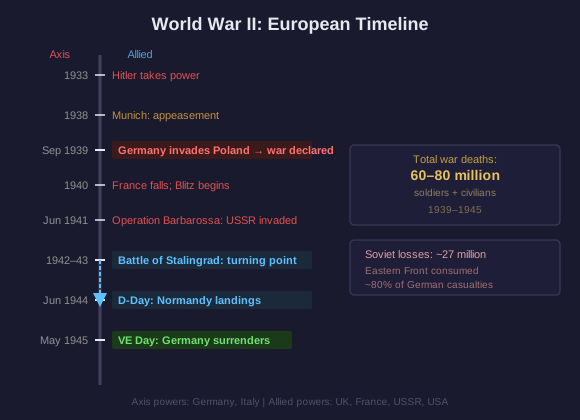
World War II was the deadliest conflict in human history.
Between 1939 & 1945, more than 60 million people died: soldiers, civilians, prisoners, children. Some estimates push that number to 80 million.
Every inhabited continent was affected. Entire cities were reduced to rubble. Populations were displaced, starved, & systematically murdered.
The war reshaped borders, governments, economies, & the moral framework of the modern world. The institutions we live under today, the United Nations, NATO, the Geneva Conventions as we know them, got built in its aftermath.
This lesson examines the turning points: the moments where the war's outcome shifted, & the decisions that still echo today.
What Do You Already Know?
Before we begin, let's see where you start from.
Hitler and Nazi Ideology
The Rise of the Third Reich
Adolf Hitler came to power in Germany in 1933: not through a coup, but through democratic elections & political maneuvering.
Germany was humiliated after World War I. The Treaty of Versailles imposed crushing reparations, stripped territory, & limited the military. The economy collapsed. People were desperate.
Hitler & the Nazi Party offered simple answers to complex problems: blame the Jews, the communists, the foreigners. Restore German greatness. Build a pure racial state.
Nazi ideology got built on antisemitism, racial supremacy, & territorial expansion: what Hitler called Lebensraum (living space) for the German people.
Once in power, the Nazis dismantled democratic institutions, burned books, persecuted Jews with escalating violence, & built concentration camps. By 1938, the machinery of the Holocaust was already being assembled.
Appeasement and the Failure to Act
Why Democracies Were Slow to Respond
Britain & France watched Hitler rearm Germany, annex Austria, & seize Czechoslovakia's Sudetenland: & did nothing.
This policy was called appeasement. British Prime Minister Neville Chamberlain flew to Munich in 1938, signed an agreement handing Hitler the Sudetenland, & returned declaring he had achieved 'peace for our time.'
Why did they appease? The memory of World War I was fresh. That war killed 17 million people & solved nothing. The British & French public had no appetite for another bloodbath. Leaders convinced themselves that Hitler's demands had a limit.
They were wrong. On September 1, 1939, Germany invaded Poland. Britain & France finally declared war: but by then, Hitler had spent years building his war machine unopposed.
The Battle of Stalingrad
Stalingrad (August 1942: February 1943)
Hitler invaded the Soviet Union in June 1941 with Operation Barbarossa: the largest military invasion in history. He expected a quick victory. He was catastrophically wrong.
The Battle of Stalingrad became the bloodiest battle in human history. An estimated 2 million people were killed, wounded, or captured: soldiers & civilians on both sides.
The Soviets fought building by building, room by room. Snipers operated from rubble. Civilians starved. The Volga River behind them meant there was nowhere to retreat. The order was: 'Not one step back.'
In November 1942, the Soviets launched a massive counterattack, encircling the German 6th Army. Hitler refused to allow a retreat. By February 1943, the surviving Germans surrendered: 91,000 frozen, starving soldiers. Only about 5,000 ever returned home.
Stalingrad broke the myth of German invincibility. After this battle, the Wehrmacht was in retreat on the Eastern Front for the rest of the war.
It is worth noting: the Soviet Union bore the heaviest cost of WWII. An estimated 27 million Soviet citizens died: nearly half of all WWII deaths. This is often underemphasized in Western accounts of the war.
The Battle of Midway
Midway (June 4–7, 1942)
In the Pacific, Japan had been on the offensive since Pearl Harbor (December 7, 1941). They swept through Southeast Asia, the Philippines, & the Pacific islands with stunning speed.
But American codebreakers cracked the Japanese naval code, JN-25, & learned that Japan planned to attack Midway Atoll, a tiny island northwest of Hawaii.
Knowing the Japanese plan in advance, the U.S. Navy set a trap. In a battle that lasted four days, American dive bombers sank four Japanese aircraft carriers: the heart of Japan's offensive naval power.
The U.S. lost one carrier. Japan lost four, along with hundreds of experienced pilots who could not be replaced.
Midway shifted the Pacific War from Japanese offense to American offense. Intelligence, not just firepower, decided the battle.
D-Day
D-Day (June 6, 1944)
By 1944, the Soviets were grinding westward, but the Western Allies had not yet opened a major front in Europe. Stalin had been demanding a second front for years.
On June 6, 1944, the Allies launched Operation Overlord: the largest amphibious invasion in history. Over 156,000 troops crossed the English Channel to land on five beaches in Normandy, France.
The planning was staggering: artificial harbors, dummy armies to deceive the Germans about the landing location, paratroopers dropped behind enemy lines in darkness.
The fighting on the beaches was brutal. At Omaha Beach, American soldiers faced cliffs, fortified bunkers, & withering machine-gun fire. Casualties on the first day exceeded 10,000 Allied troops.
But the beachheads held. Within a month, over a million Allied soldiers were in France. Paris was liberated in August. The vise was closing on Nazi Germany from both east & west.
Which Turning Point Mattered Most?
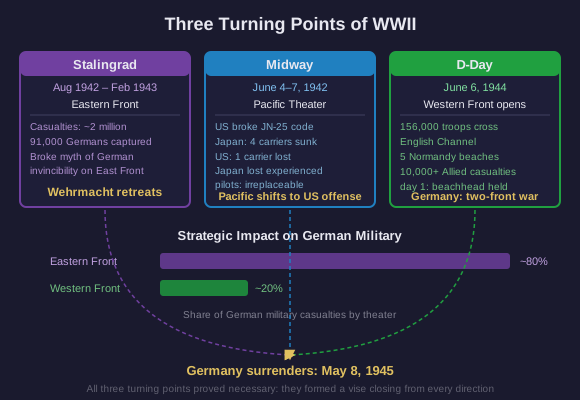
You have now studied three pivotal moments:
- Stalingrad: Soviet tenacity broke the German army on the Eastern Front
- Midway: American intelligence turned the tide in the Pacific
- D-Day: the Allies opened a second front in Western Europe
War at Home
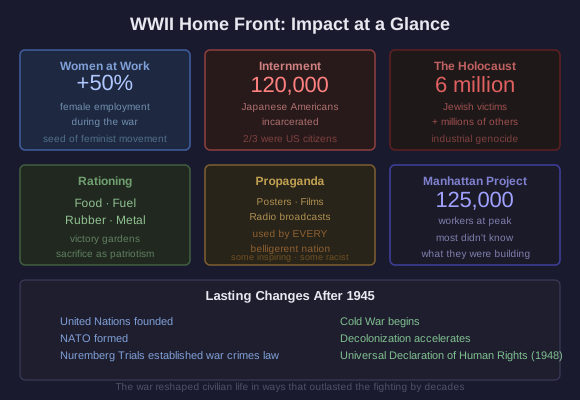
The Home Front
WWII was not just fought by soldiers. Entire societies were mobilized.
Women in the workforce: With millions of men overseas, women filled factory jobs, built planes, welded ships, & drove trucks. Rosie the Riveter became the symbol of women's wartime labor. In the U.S., female employment rose by 50% during the war. After the war, many women were pushed back out of the workforce: but the genie was out of the bottle. The war planted seeds for the feminist movements that followed.
Rationing & sacrifice: Governments rationed food, fuel, rubber, & metal. Families grew 'victory gardens.' Propaganda posters urged citizens to save, sacrifice, & suspect spies.
Propaganda: Every belligerent nation used propaganda, posters, films, radio, to sustain public support. Some of it was inspiring. Some was racist, dehumanizing, & designed to make killing easier.
Japanese American internment: In February 1942, President Roosevelt signed Executive Order 9066, forcing over 120,000 Japanese Americans, two-thirds of them U.S. citizens, into internment camps. They lost their homes, businesses, & freedom. There was no evidence of disloyalty. It was racism wrapped in the flag of national security. The U.S. government formally apologized in 1988, but the damage was done.
The Holocaust: While home fronts mobilized, Nazi Germany carried out the systematic murder of six million Jews, along with millions of Roma, disabled people, homosexuals, political prisoners, & others. The Holocaust was industrial genocide: gas chambers, death marches, medical experiments. It remains the defining atrocity of the 20th century.
The Manhattan Project
The Bomb
In 1939, Albert Einstein signed a letter to President Roosevelt warning that Nazi Germany might develop an atomic bomb. Roosevelt launched the Manhattan Project: a secret, massive scientific effort to build the weapon first.
At its peak, the project employed over 125,000 people across multiple secret sites. Many workers did not know what they were building.
On July 16, 1945, the first atomic bomb was tested at Trinity Site in New Mexico. J. Robert Oppenheimer, the project's scientific director, later said he thought of a line from Hindu scripture: 'Now I am become Death, the destroyer of worlds.'
Germany had already surrendered in May 1945. But Japan fought on.
Hiroshima and Nagasaki
The Decision
President Harry Truman faced a choice that haunts history.
Japan showed no signs of surrendering. American military planners estimated that an invasion of Japan (Operation Downfall) could cost hundreds of thousands of American lives & potentially millions of Japanese lives: soldiers & civilians.
On August 6, 1945, the B-29 bomber Enola Gay dropped an atomic bomb on Hiroshima. The blast killed approximately 80,000 people instantly. By the end of the year, the death toll reached an estimated 140,000 from burns, radiation, & injuries.
Japan did not surrender.
On August 9, a second bomb was dropped on Nagasaki, killing approximately 40,000 people instantly & up to 70,000 by year's end.
Japan surrendered on August 15, 1945.
The Debate
Was the bombing justified? This remains one of the most contested moral questions in modern history.
Arguments for: It ended the war quickly, avoided a land invasion that would have killed far more on both sides, & demonstrated the weapon's horror in a way that arguably prevented nuclear war during the Cold War.
Arguments against: Japan was already on the verge of defeat. The targets were cities full of civilians, including children. The U.S. could have demonstrated the bomb on an uninhabited area. The bombings were partly motivated by a desire to intimidate the Soviet Union. Using weapons of mass destruction against civilian populations is a war crime by any consistent moral standard.
Other perspectives: Some historians argue Japan's military leadership would not have surrendered even after a demonstration. Others point out that the Soviet Union's declaration of war on Japan (August 8) may have been equally decisive in forcing surrender.
There is no comfortable answer. Honest engagement with this question requires holding multiple truths at once.
The World After the War
What Came After
The world that emerged from WWII was fundamentally different from the one that entered it.
The United Nations was founded in 1945 to prevent another global war. Its track record is mixed, it has prevented some conflicts & failed to stop others, but the principle of international cooperation was born from the ashes of WWII.
The Nuremberg Trials (1945–1946) established that individuals, including heads of state, could be held accountable for war crimes & crimes against humanity. 'I was following orders' was rejected as a defense. This was a new principle in international law.
The Universal Declaration of Human Rights (1948) attempted to define the basic rights every person is entitled to, regardless of nationality. It was drafted in direct response to the horrors of the Holocaust.
The Cold War began almost immediately. The U.S. & the Soviet Union, allies against Hitler, became rivals with nuclear weapons. The world lived under the threat of annihilation for the next 45 years.
Decolonization accelerated. European empires, weakened & discredited by the war, began losing their colonies in Asia & Africa. The postwar order created new nations & new conflicts that persist today.
The State of Israel was established in 1948, driven in part by the Holocaust's demonstration that European Jews needed a homeland. This decision created a conflict with the Palestinian people that remains unresolved.