Welcome
In 1787, fifty-five men gathered in a sweltering room in Philadelphia & tried to do something no one had ever done: design a government from scratch.
They were imperfect people. Some owned slaves. Some distrusted ordinary citizens. They argued for months. Several walked out.
What they produced was the United States Constitution: a document that has been amended, reinterpreted, fought over, & defended for more than 230 years.
It is not sacred scripture. It is a living document, built to be changed. And understanding it is one of the most important things you can do as a citizen.
Warm-Up
Before we dig into the actual document, let's start with a thought experiment.
Three Branches
The Architecture of Power
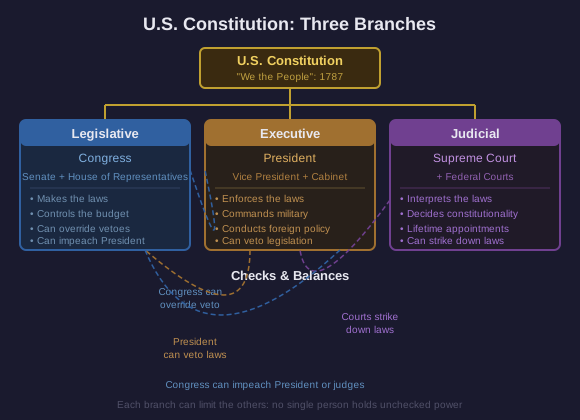
The founders had just fought a war against a king. They were terrified of concentrated power. So they split the government into three separate branches:
Legislative (Congress): makes the laws. Split into the Senate & the House of Representatives.
Executive (President): enforces the laws. Commands the military. Conducts foreign policy.
Judicial (Supreme Court & federal courts): interprets the laws. Decides whether actions are constitutional.
Each branch can check the others. The President can veto laws. Congress can override vetoes. The courts can strike down laws as unconstitutional. Congress can impeach the President or federal judges.
This system is called checks & balances, & its whole purpose is to make sure no single person or group gets too much power.
The First Ten Amendments
The Bill of Rights
The original Constitution described the structure of government but said very little about individual rights. Many people refused to support it without explicit protections.
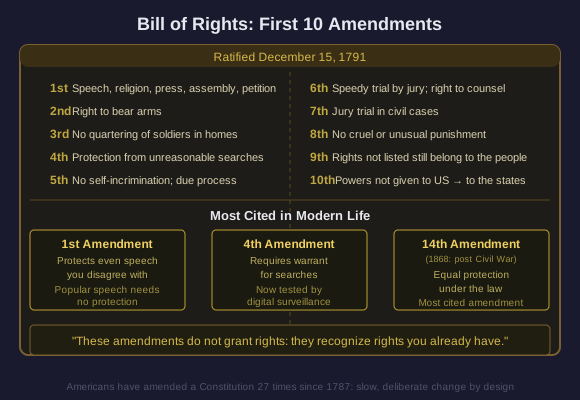
So in 1791, the first ten amendments were added. They are called the Bill of Rights.
1st Amendment: Freedom of speech, religion, the press, assembly, & petition. The government cannot silence you, force a religion on you, or shut down newspapers.
2nd Amendment: The right to keep & bear arms. One of the most debated amendments in modern politics.
4th Amendment: Protection against unreasonable searches & seizures. The police cannot search your home without a warrant.
5th Amendment: You cannot be forced to testify against yourself. This is where 'pleading the Fifth' comes from.
These amendments do not grant you rights: they recognize rights you already have & forbid the government from taking them away.
The Amendments That Transformed America
Amendments That Changed Everything
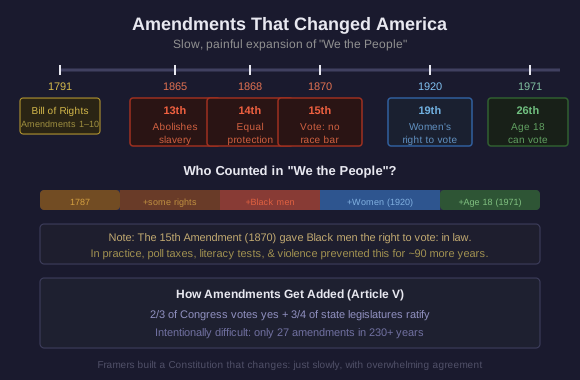
The Constitution got designed to be amended: Article V lays out the process. It is intentionally difficult (two-thirds of Congress plus three-fourths of state legislatures), which means amendments only pass when there is overwhelming agreement.
Some amendments corrected deep injustices that the original document failed to address:
13th Amendment (1865): Abolished slavery. It took a civil war to get here.
14th Amendment (1868): Equal protection under the law for all persons. This amendment has been used in more Supreme Court cases than almost any other.
15th Amendment (1870): The right to vote cannot be denied based on race. (In practice, states found ways around this for another century.)
19th Amendment (1920): Women gain the right to vote. It took 131 years.
26th Amendment (1971): 18-year-olds gain the right to vote. The argument: if you are old enough to be drafted & sent to war, you are old enough to vote.
Notice the pattern: the Constitution's history is a slow, painful expansion of the word 'people' in 'We the People.'
The Tensions Built Into the System
Constitutional Tensions
The Constitution does not resolve every question: it creates a framework for arguing about them. Some of the biggest tensions in American life come straight from the document:
Federal vs. state power: The 10th Amendment says powers not given to the federal government belong to the states. But the 'necessary & proper' clause gives Congress flexibility. This tension has fueled arguments from the Civil War to marijuana legalization.
Individual rights vs. collective safety: Your rights are not absolute. You cannot yell 'fire' in a crowded theater. But where is the line? Every generation re-draws it.
Majority rule vs. minority rights: Democracy means the majority decides. But the Bill of Rights protects minorities from the majority. What happens when those principles collide?
These tensions are not defects. The founders built them in deliberately, because they knew rigid rules break. Flexible frameworks bend.
The Constitution and You
How the Constitution Affects You Right Now
You do not have to wait until you are 18 to be affected by the Constitution. It shapes your life as a student every day:
Free speech in school: The Supreme Court ruled in Tinker v. Des Moines (1969) that students do not 'shed their constitutional rights at the schoolhouse gate.' You can wear a political armband, write an editorial, or express an opinion, as long as it does not substantially disrupt school operations.
Search & seizure: Schools can search your locker or backpack, but courts have set limits. The standard is lower than for police (reasonable suspicion vs. probable cause), but your rights still exist.
Religious freedom: Schools cannot force you to pray or promote a religion. But you have the right to pray privately, form religious clubs, & express religious views.
Due process: If you face suspension or expulsion, you have a right to notice & a hearing. The government (including public schools) cannot punish you without a fair process.
The Constitution is not an abstract document in a museum. It is the reason your school cannot expel you without a hearing, cannot force you to salute the flag, & cannot search you without reason.