Welcome
Why does a diamond cost more than water?
Water is essential for life. Diamonds are pretty rocks. By any survival measure, water should be more expensive: but it isn't.
This puzzle baffled economists for centuries. It even has a name: the diamond-water paradox.
The answer lies in supply and demand: the two forces that set nearly every price you encounter, from a gallon of gas to a monthly streaming subscription.
By the end of this lesson, you will understand how those forces work, what happens when they collide, & why governments sometimes try to override them.
Warm-Up
Before We Start
Prices change all the time. Some things that used to be expensive are now cheap (flat-screen TVs, calculators). Some things that used to be cheap are now expensive (concert tickets, housing in big cities).
Law of Demand
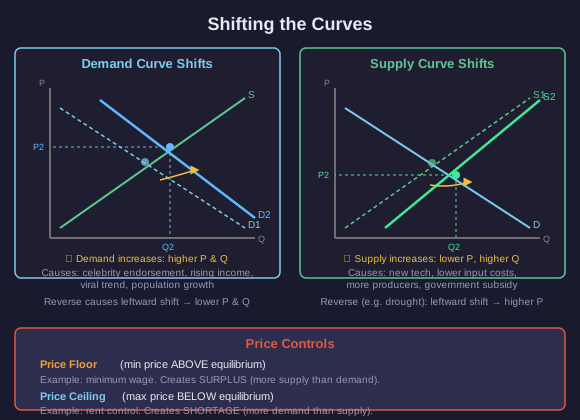
What Is Demand?
Demand is the quantity of a good or service that people are willing & able to buy at a given price.
The law of demand says: when the price of something goes up, the quantity demanded goes down: and when the price goes down, the quantity demanded goes up.
This is intuitive. If your favorite streaming service doubled its price tomorrow, some people would cancel. If it dropped to $1/month, more people would subscribe.
When we plot this relationship on a graph, we get a demand curve: it slopes downward from left to right.
What Shifts the Demand Curve?
The demand curve itself can shift: meaning people want more or less at every price: because of:
- Tastes and preferences: a viral trend makes something popular
- Income: people earn more and buy more
- Substitutes: a competing product gets cheaper
- Complements: a related product gets more expensive (phones and phone cases)
- Expectations: people expect prices to rise, so they buy now
- Number of buyers: population growth increases total demand
Law of Supply
What Is Supply?
Supply is the quantity of a good or service that producers are willing & able to sell at a given price.
The law of supply says: when the price goes up, the quantity supplied goes up: and when the price goes down, the quantity supplied goes down.
This also makes sense. If the price of coffee doubles, coffee farmers want to grow more of it because they earn more per bag. If the price crashes, some farmers switch to growing something else.
On a graph, the supply curve slopes upward from left to right: the opposite of the demand curve.
What Shifts the Supply Curve?
Just like demand, the supply curve can shift:
- Technology: better machines make production cheaper and faster
- Input costs: raw materials, labor, or energy get more or less expensive
- Natural events: droughts, floods, or diseases destroy crops or resources
- Government policies: taxes, subsidies, or regulations change production costs
- Number of sellers: more producers enter the market
Where Supply Meets Demand
Equilibrium
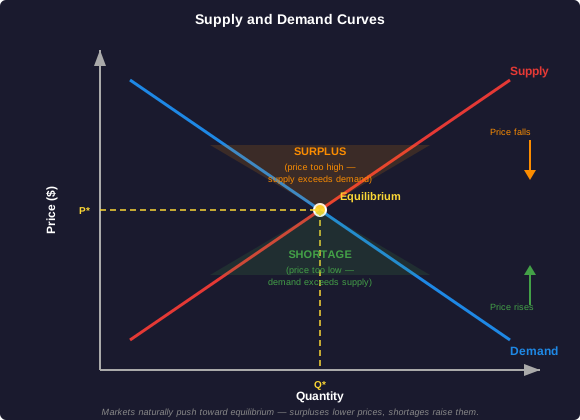
When we put the supply curve & demand curve on the same graph, they cross at a single point.
That point is called the equilibrium: the price where the quantity buyers want to buy exactly equals the quantity sellers want to sell.
At the equilibrium price, there is no leftover product sitting unsold, & no frustrated buyer who cannot find one.
What Happens Away from Equilibrium?
- Surplus: the price is too high. Sellers produce more than buyers want. Unsold goods pile up. Sellers lower prices to clear inventory.
- Shortage: the price is too low. Buyers want more than sellers produce. Empty shelves, long lines, sold-out signs. Sellers raise prices or buyers bid prices up.
Markets naturally push toward equilibrium. Surpluses push prices down; shortages push prices up.
Floors and Ceilings
When Governments Step In
Sometimes governments decide the market equilibrium price is unfair: too low for sellers or too high for buyers. So they impose price controls.
Price Floor
A price floor is a minimum price set above equilibrium. Sellers cannot charge less than this amount.
The most common example is the minimum wage: the government says employers must pay at least a certain amount per hour.
Effect: at the higher price, quantity supplied (workers wanting jobs) exceeds quantity demanded (employers wanting to hire). This can create a surplus of labor: unemployment.
Price Ceiling
A price ceiling is a maximum price set below equilibrium. Sellers cannot charge more than this amount.
The most common example is rent control: the government caps how much landlords can charge.
Effect: at the lower price, quantity demanded (renters wanting apartments) exceeds quantity supplied (landlords willing to rent). This creates a shortage: long waiting lists, deteriorating buildings, and a black market.
The Pattern
Price controls often have unintended consequences. The intention is to help people, but the market responds in ways that can hurt the very people the policy was meant to protect.
Prices in the Wild
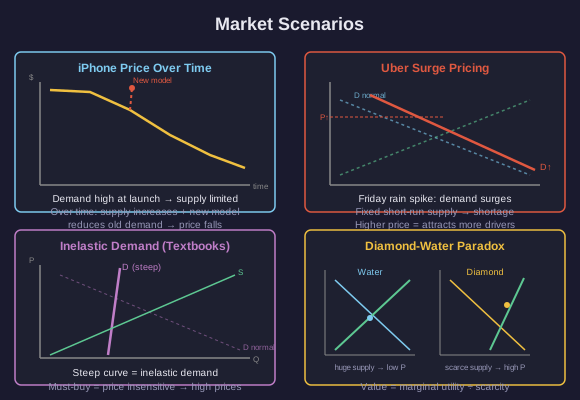
Supply & Demand Everywhere
Now that you understand the framework, you can decode prices you see every day.
Why do iPhone prices drop after a year?
When a new model launches, demand is high and supply is limited: classic shortage conditions, high prices. Over time, production ramps up (supply increases), a newer model steals attention (demand decreases), and the price falls.
Why does Uber use surge pricing?
On a rainy Friday night, demand for rides spikes. The number of available drivers (supply) is fixed in the short run. Uber raises prices to reduce quantity demanded & attract more drivers (increase supply). It is real-time equilibrium adjustment.
Why do textbooks cost so much?
Professors choose the book: students have to buy it. That means demand is very inelastic (it does not change much when price goes up). Publishers know students will pay almost any price, so they charge a lot. There are also few substitutes, which keeps demand high.