Welcome
Today we will read the most famous speech in the English language.
It comes from Hamlet, written by William Shakespeare around the year 1600.
Shakespeare wrote 37 plays: comedies, histories, tragedies: but Hamlet is the most performed play in the world. It has been staged, filmed, and adapted more than any other work in theater history.
The Story
What Happens in Hamlet?
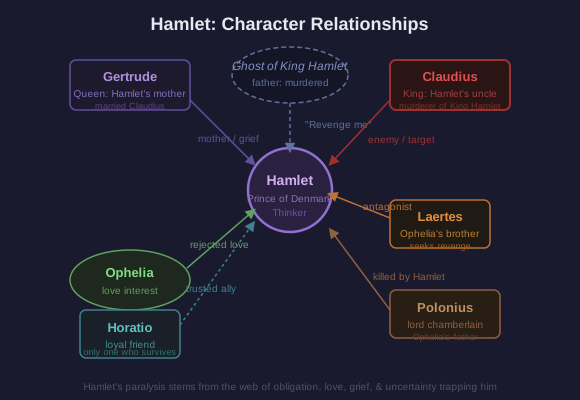
Here is the setup: Prince Hamlet's father, the King of Denmark, has died. His uncle Claudius has married Hamlet's mother & taken the throne.
Then a ghost appears: the ghost of Hamlet's dead father. The ghost tells Hamlet a terrible secret: Claudius murdered him. Poured poison in his ear while he slept.
The ghost demands revenge. But Hamlet is a thinker, not a warrior. He is paralyzed by the weight of what he has been asked to do.
And in the middle of this crisis, alone on stage, Hamlet speaks the most famous words in all of literature.
To Be or Not to Be
The Soliloquy
A soliloquy is when a character speaks their thoughts aloud on stage, alone. The audience hears what no other character can. It is thinking out loud: raw, unfiltered, private.
Here is Hamlet's most famous soliloquy, from Act 3, Scene 1:
To be, or not to be: that is the question:
Whether 'tis nobler in the mind to suffer
The slings & arrows of outrageous fortune,
Or to take arms against a sea of troubles
And, by opposing, end them. To die, to sleep:
No more: and by a sleep to say we end
The heartache & the thousand natural shocks
That flesh is heir to: 'tis a consummation
Devoutly to be wished. To die, to sleep;
To sleep, perchance to dream. Ay, there's the rub,
For in that sleep of death what dreams may come
When we have shuffled off this mortal coil
Must give us pause. There's the respect
That makes calamity of so long life.
For who would bear the whips & scorns of time,
Th' oppressor's wrong, the proud man's contumely,
The pangs of despised love, the law's delay,
The insolence of office, & the spurns
That patient merit of th' unworthy takes,
When he himself might his quietus make
With a bare bodkin? Who would fardels bear,
To grunt & sweat under a weary life,
But that the dread of something after death,
The undiscovered country from whose bourn
No traveler returns, puzzles the will
And makes us rather bear those ills we have
Than fly to others that we know not of?
Thus conscience does make cowards of us all,
And thus the native hue of resolution
Is sicklied o'er with the pale cast of thought,
And enterprises of great pitch & moment
With this regard their currents turn awry,
And lose the name of action.
Take a moment to read it again slowly. Let the language wash over you.
Key Phrases
Breaking Down the Language
Shakespeare packed this speech with vivid images. Let's look at three of the most important phrases.
"The slings & arrows of outrageous fortune"
Hamlet imagines life's troubles as weapons: slings (like a sling that hurls stones) and arrows: fired at us by fortune, which is cruel and unfair. Life attacks you, and you have to decide whether to take it.
"To sleep, perchance to dream"
Hamlet compares death to sleep: which sounds peaceful. But then he catches himself: if death is sleep, there might be dreams. And what kind of dreams come in death? This is what terrifies him. Death might not be the escape he hopes for.
"The undiscovered country from whose bourn no traveler returns"
This is Hamlet's name for death: an undiscovered country. A place no one has ever come back from. A bourn is a boundary or border. Once you cross it, there is no return.
Passive vs Active
The Real Debate
This speech is often reduced to a question about suicide. But it is bigger than that.
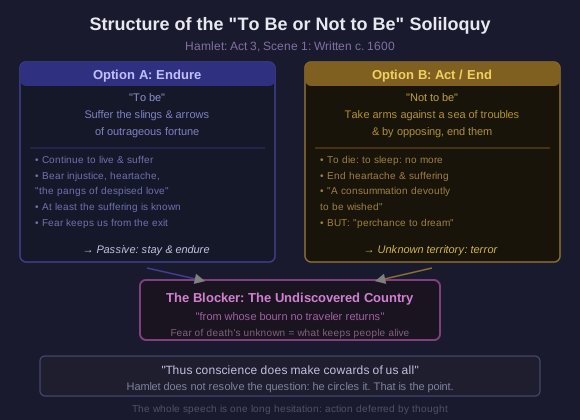
Hamlet is asking: is it better to endure injustice or to fight back?
Look at the first few lines again:
Whether 'tis nobler in the mind to suffer / The slings & arrows of outrageous fortune, / Or to take arms against a sea of troubles / And, by opposing, end them.
Option A: suffer passively. Accept what life throws at you.
Option B: take action. Fight back: even if it means your own destruction.
Hamlet has been told to avenge his father's murder. He knows what he should do. But he cannot bring himself to act. The entire play is about this paralysis.
How Shakespeare Writes
The Music of the Speech
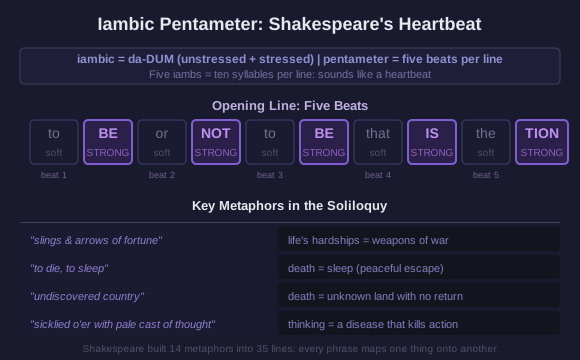
Shakespeare wrote most of Hamlet in iambic pentameter: a rhythm of five beats per line, alternating unstressed and stressed syllables: da-DUM da-DUM da-DUM da-DUM da-DUM.
Listen to the opening: to BE or NOT to BE that IS the QUES-tion. Five beats. It sounds like a heartbeat.
But Shakespeare was not just a musician of rhythm. He was a master of metaphor: describing one thing in terms of another to make you see it differently.
In this speech alone, life is a battle (slings & arrows), death is sleep (to die, to sleep), sleep contains dreams (perchance to dream), death is an undiscovered country, & thinking is a disease that makes resolution sick (sicklied o'er with the pale cast of thought).
Notice also that the entire speech comes from questions, not answers. Shakespeare understood that the most powerful thing a writer can do is ask a question so good that it haunts you.
Hamlet Lives On
Hamlet in the Modern World
Every superhero movie has a 'to be or not to be' moment: the scene where the hero must decide whether to accept responsibility or walk away.
And Hamlet's plot has been retold more times than you might think. The Lion King is literally the Hamlet story: a prince whose father is murdered by his uncle, who takes the throne, while the prince goes into exile & must decide whether to return & fight.
Hamlet shows up in science fiction, in video games, in hip-hop, in courtroom dramas. Any time a character is paralyzed by a choice between action and inaction: between justice and self-preservation: you are watching Hamlet's dilemma.
The reason this play endures is not because it answers the question. It is because it asks it so perfectly that every generation recognizes their own struggle in it.
What Will You Remember?
One Last Thought
You have just read & analyzed the most famous speech in the English language.
Four hundred years after Shakespeare wrote it, people still quote it, argue about it, & see themselves in it.
That is the power of asking the right question.