Welcome
Today we will explore one of the oldest & most powerful ideas in all of mathematics.
It is called the Pythagorean Theorem, & it has been used for over 2,500 years: by ancient builders, sailors, engineers, & even your phone's GPS.
The theorem is named after Pythagoras, a Greek mathematician who lived around 570–495 BCE. He led a community of scholars who believed that numbers were the secret language of the universe.
But here is the thing: the Babylonians knew this relationship at least 1,000 years before Pythagoras was born. A clay tablet called Plimpton 322, dating to around 1800 BCE, contains Pythagorean triples: proof that ancient Mesopotamians understood the pattern long before the Greeks.
By the end of this lesson, you will be able to use this theorem to find missing distances, check right angles, & see geometry hiding in everyday life.
Warm-Up
A Problem Worth Solving
Imagine you are standing on one side of a lake. You can see a tree on the other side, directly across the water. You have a tape measure, but you definitely do not want to swim.
What Makes a Right Triangle?
The Right Triangle
A right triangle is a triangle that has one angle measuring exactly 90 degrees: a perfect square corner.
You see right angles everywhere: the corner of a book, the edge of a door frame, the intersection of a wall & a floor.
The two sides that form the right angle are called the legs.
The side across from the right angle, the longest side, is called the hypotenuse.
Here is the big idea, discovered thousands of years ago:
a² + b² = c²
where a & b are the legs, & c is the hypotenuse.
In words: if you draw a square on each side of a right triangle, the area of the two smaller squares adds up exactly to the area of the largest square.
Visual Proof
Seeing It with Squares
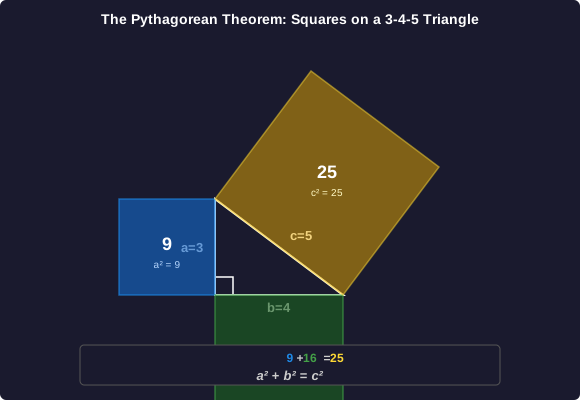
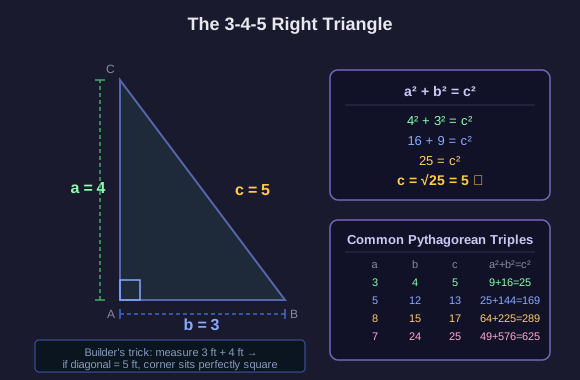
Picture a right triangle with legs of length 3 & 4.
Now imagine drawing a square on each side:
- The square on the leg of length 3 has area 3² = 9
- The square on the leg of length 4 has area 4² = 16
- The square on the hypotenuse has area 9 + 16 = 25
And what is the square root of 25? It is 5.
So the hypotenuse is 5 units long. That is the 3-4-5 right triangle: the most famous one in all of geometry.
Ladder Problem
Finding Missing Sides
The Pythagorean Theorem is not just for finding the hypotenuse. You can rearrange it to find any missing side.
To find a leg: a² = c² - b²
Let's try a classic problem.
A ladder is 10 feet long & leans against a wall. The base of the ladder is 6 feet from the wall.
The wall, the ground, & the ladder form a right triangle. The ladder is the hypotenuse (it is the longest side, slanting across from the right angle between the wall & the ground).
The ground distance (6 feet) is one leg. The height up the wall is the other leg: & that is what we need to find.
Famous Triples
Pythagorean Triples
A Pythagorean triple is a set of three whole numbers that satisfy a² + b² = c².
Here are the most common ones:
- 3, 4, 5: the classic (9 + 16 = 25)
- 5, 12, 13: (25 + 144 = 169)
- 8, 15, 17: (64 + 225 = 289)
The Builder's 3-4-5 Rule
Carpenters & construction workers use the 3-4-5 triple every day to make perfect right angles.
Here is how it works: when you need a square corner, for a foundation, a deck, or a fence, measure 3 feet along one side & 4 feet along the other. If the diagonal between those two points is exactly 5 feet, your corner is a perfect 90 degrees.
This trick has been used since the ancient Egyptians built the pyramids. They called the people who did this rope stretchers: they used knotted ropes measured in units of 3, 4, & 5.
From Triangles to Coordinates
Connecting to Coordinate Geometry
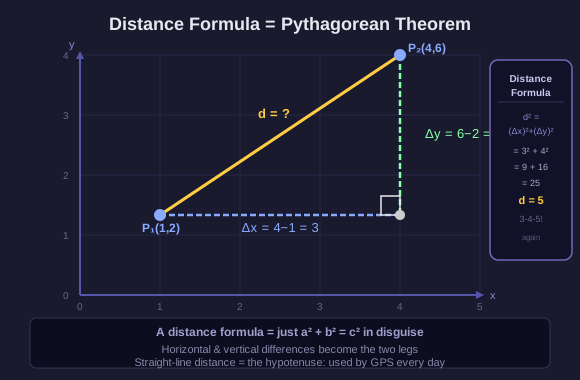
The Pythagorean Theorem does not just live in geometry class: it is the engine behind the distance formula you use on a coordinate plane.
Here is the connection: if you want to find the distance between two points, you can draw a right triangle where the distance is the hypotenuse.
Say you have two points: (x₁, y₁) & (x₂, y₂).
- The horizontal distance between them is (x₂ - x₁): that is one leg.
- The vertical distance between them is (y₂ - y₁): that is the other leg.
- The straight-line distance is the hypotenuse.
Apply the Pythagorean Theorem:
d² = (x₂ - x₁)² + (y₂ - y₁)²
d = √((x₂ - x₁)² + (y₂ - y₁)²)
That is it. The distance formula is just the Pythagorean Theorem wearing a coordinate-geometry disguise.
Pythagorean Theorem in the Wild
The Theorem Is Everywhere
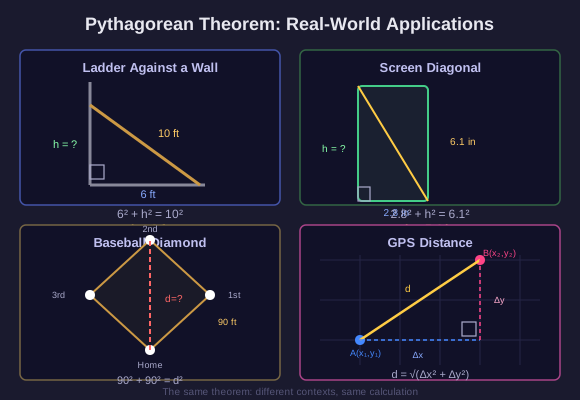
The Pythagorean Theorem is one of the most practically useful ideas in all of mathematics. Here is where it shows up in real life:
Navigation & GPS: Your phone calculates distances between coordinates using the distance formula, which is the Pythagorean Theorem. At small scales, latitude & longitude form a grid, & straight-line distances are hypotenuses.
Architecture & Construction: Every right angle in every building was checked using this theorem. The 3-4-5 rope-stretching trick is still used on construction sites today.
Screen Sizes: When a TV or phone is advertised as having a 55-inch screen or a 6.1-inch display, that number is the diagonal measurement. The diagonal of a rectangle is the hypotenuse of the right triangle formed by its width & height.
Sports: How far does a baseball travel from home plate to second base? The bases form a square, & the throw is the diagonal, a Pythagorean problem.