Welcome
Memory makes you who you are.
Every skill you have learned, every person you recognize, every word you understand: all of it depends on memory.
But here is something that might unsettle you: your memory is not a video camera. It does not record events faithfully & play them back on demand.
Memory is more like a Wikipedia article: it is constantly being edited, rewritten, & sometimes filled with information that was never there in the first place.
In this lesson, you will learn how memories are formed, why you forget, & why your brain sometimes remembers things that never happened.
Your Earliest Memory
Warm-Up
Before we dive in, let's start with something personal.
Three-Stage Model
The Three Stages of Memory
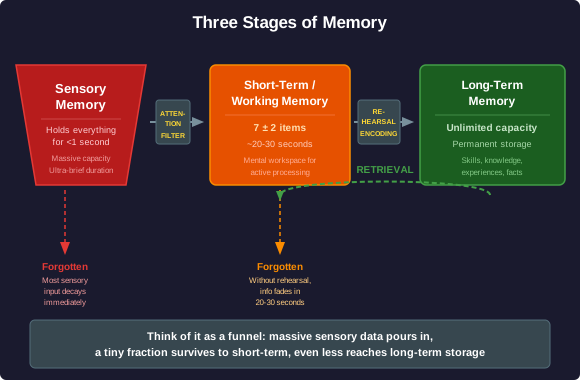
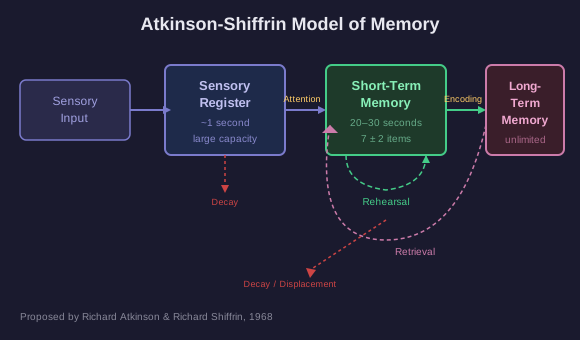
Psychologists describe memory as flowing through three stages, each with different capacities & durations:
1. Sensory Memory, lasts milliseconds to a few seconds. This is the raw flood of information from your senses. You see a flash of lightning; for a split second, the image lingers in your mind. Then it is gone, unless your brain decides it matters.
2. Short-Term (Working) Memory, lasts about 20–30 seconds without rehearsal. It holds roughly 7 ± 2 items at a time (this explains why phone numbers are 7 digits). This is your mental workspace, where you hold a math problem while solving it, or remember the beginning of a sentence while reading the end.
3. Long-Term Memory: potentially unlimited capacity & duration. Memories that survive rehearsal, emotional intensity, or repeated use get stored here. Some last a lifetime.
Think of it as a funnel: massive amounts of sensory data pour in, a tiny fraction makes it to short-term memory, & an even smaller fraction gets encoded into long-term storage.
How Memories Form
Encoding: The Gatekeeper
Encoding is the process of converting an experience into a memory. Think of it as writing something down in a notebook: if you never write it down, it is gone.
Attention is the gatekeeper. You cannot encode what you do not attend to. This explains why you can drive a familiar route & arrive with no memory of the trip: your attention was elsewhere, so nothing was encoded.
There are two main ways to encode information:
Rote repetition: saying something over & over. This works, but it is slow & fragile. If you memorized the capitals of all 50 states by repeating them, you would forget most within weeks.
Elaborative rehearsal, connecting new information to things you already know. This is far more effective. Instead of repeating 'Tallahassee is the capital of Florida,' you might think: 'Tallahassee sounds like tally, imagine someone tallying votes in Florida.' Now you have a hook.
One more crucial fact: sleep consolidates memories. During sleep, your brain replays the day's experiences & strengthens the neural connections that form memories. This is not a metaphor: it is measurable brain activity. Pulling an all-nighter before a test is actively sabotaging your memory.
Getting Memories Back
Retrieval: Finding What You Stored
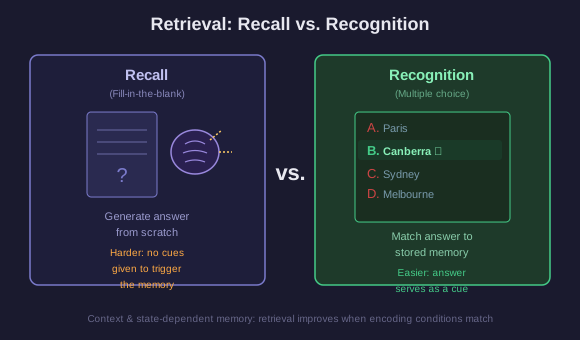
Encoding is only half the story. You also need to retrieve memories: pull them back out when you need them.
There are two main types of retrieval:
Recall: generating information from scratch. Fill-in-the-blank tests, essay questions, & trying to remember someone's name all require recall. There are no hints. You have to search your memory & produce the answer.
Recognition: identifying information when you see it. Multiple-choice tests, picking a face out of a lineup, & hearing a song & knowing you have heard it before all use recognition. The answer is in front of you; you just have to match it to what is in your memory.
Context-dependent memory: You retrieve memories better in the same environment where you encoded them. Students who study in the room where they will take the test perform better. This explains why you might walk into the kitchen & forget why: your memory was encoded in a different room.
State-dependent memory: Your emotional & physical state matters too. What you learn while calm is easier to recall when calm. What you learn while caffeinated is easier to recall while caffeinated.
The tip-of-the-tongue phenomenon: That maddening feeling when you KNOW you know something but cannot quite retrieve it. You might remember the first letter, or how many syllables the word has, but the full memory will not surface. This proves the memory is there: the retrieval pathway is just temporarily blocked.
Why We Forget — and Why We 'Remember' Things That Never Happened
The Forgetting Curve
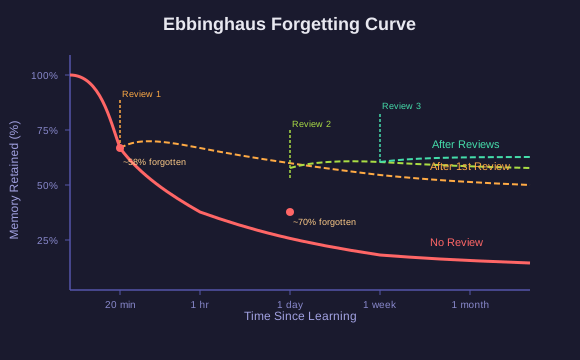
In 1885, German psychologist Hermann Ebbinghaus memorized lists of nonsense syllables & tested himself over time. He discovered something striking: forgetting is not gradual. It is steep & fast at first, then levels off.
Within 20 minutes, you forget about 40% of newly learned material. Within a day, about 70%. After a week, you may retain only 20–25%: unless you review.
This is the forgetting curve, & it explains why cramming fails. You can stuff information into short-term memory the night before, but without spaced review, most of it will be gone within days.
Interference
Sometimes you forget because other memories get in the way. Proactive interference is when old memories block new ones (your old phone number keeps popping up instead of your new one). Retroactive interference is when new memories disrupt old ones (after learning your new phone number, you can no longer remember the old one).
False Memories
Now for the truly unsettling part.
Psychologist Elizabeth Loftus has spent decades proving that memory is not just unreliable: it is actively reconstructive. Your brain does not store memories like files on a computer. Every time you recall a memory, you rebuild it from fragments, & in the process, you can accidentally change it.
In her famous studies, Loftus showed people videos of car accidents & then asked leading questions. When she asked 'How fast were the cars going when they smashed into each other?' people estimated higher speeds AND were more likely to 'remember' seeing broken glass: even though there was none.
She has also successfully implanted entirely false memories in research subjects: convincing adults they were lost in a shopping mall as children, or that they once met Bugs Bunny at Disneyland (impossible, since Bugs Bunny is a Warner Bros. character).
Eyewitness testimony, once considered the gold standard of evidence, is now known to be one of the least reliable forms of evidence. The Innocence Project has found that mistaken eyewitness identification is the leading cause of wrongful convictions in the United States.
Tools for Better Memory
Using What You Know
Now that you understand how memory works, you can use that knowledge to your advantage. Here are three evidence-based techniques:
Memory Palaces (Method of Loci): Imagine a place you know well (your house, your school). Mentally place each item you want to remember in a specific location. To recall the list, mentally walk through the space. This works because spatial memory is deeply encoded & provides strong retrieval cues. Memory champions use this technique to memorize thousands of digits.
Spaced Repetition: Instead of studying everything once, review material at increasing intervals: after 1 day, then 3 days, then 1 week, then 2 weeks. Each review session resets the forgetting curve. This is the single most effective technique for long-term retention. Apps like Anki are built on this principle.
Chunking: Group individual items into meaningful clusters. The number 1-9-4-5-1-9-6-9 is 8 items (too many for working memory). But 1945-1969 is 2 chunks, the end of World War II & the moon landing. Chunking lets you bypass the 7 ± 2 limit by redefining what counts as an 'item.'
Notice something: all three techniques work because they align with how memory actually functions. Memory palaces use elaborative encoding & spatial cues. Spaced repetition fights the forgetting curve. Chunking respects the limits of working memory.