Welcome
Every time you check the weather forecast, play a card game, or wonder if your toast will land butter-side down, you think about probability.
Probability is the branch of mathematics that quantifies uncertainty. It gives us a way to measure how likely something is to happen: & how unlikely.
Casinos are built on it. Weather forecasts depend on it. Medical tests live or die by it. Insurance companies price their products with it.
In this lesson, you will learn how to calculate probabilities, spot common mistakes in probabilistic thinking, & understand why the house always wins.
Warm-Up Question
Before we start, let's test your intuition.
Formula
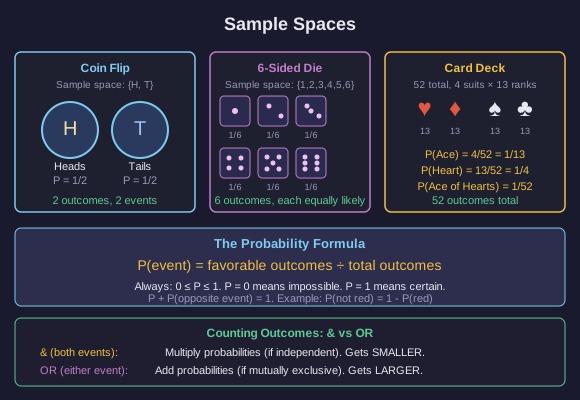
The Probability Formula
Probability measures how likely an event is to happen, on a scale from 0 (impossible) to 1 (certain).
The basic formula is simple:
P(event) = favorable outcomes / total outcomes
Some examples:
- Coin flip (heads): 1 favorable outcome / 2 total outcomes = 1/2 = 0.5 = 50%
- Rolling a 6 on a die: 1 favorable / 6 total = 1/6 ≈ 16.7%
- Drawing an ace from a deck: 4 aces / 52 cards = 4/52 = 1/13 ≈ 7.7%
The key is counting: how many ways can the thing happen, out of how many total possibilities?
Practice Problem
Let's practice with a classic problem.
A bag contains 3 red marbles & 5 blue marbles. You reach in & draw one marble without looking.
AND and OR
Combining Probabilities
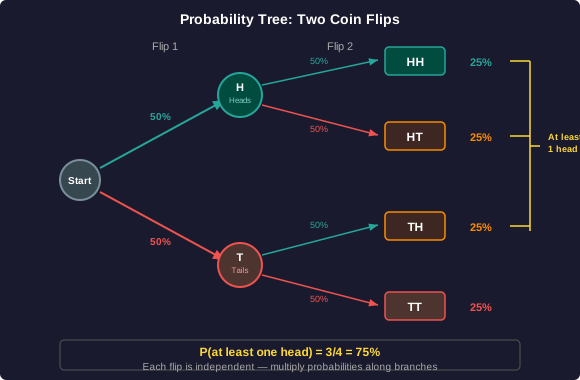
Sometimes we want to know the probability of more than one thing happening.
There are two main rules:
AND (both events happen): Multiply the probabilities
- This works when the events are independent: one does not affect the other.
- Example: P(heads AND heads) = 1/2 × 1/2 = 1/4
OR (either event happens): Add the probabilities
- This works when the events are mutually exclusive: they cannot both happen at the same time.
- Example: P(rolling a 1 OR a 2) = 1/6 + 1/6 = 2/6 = 1/3
Think of it this way: AND makes things less likely (you need both to happen). OR makes things more likely (you only need one).
Practice Problem
Here is a compound probability problem.
You flip a fair coin & roll a fair six-sided die at the same time.
Roulette Wheel Has No Memory
The Gambler's Fallacy
In 1913 at the Monte Carlo Casino, the roulette ball landed on black 26 times in a row. Gamblers rushed to bet on red, convinced it was 'due.' They lost millions.
This mistake is so common it has a name: the Gambler's Fallacy.
The fallacy is believing that past results affect future independent events. But a roulette wheel has no memory. A coin has no memory. Dice have no memory.
Each spin, flip, or roll is a fresh start with the same probabilities as always.
Why do our brains make this mistake? Because humans are pattern-seekers. We evolved to find patterns: but sometimes we find patterns where none exist.
Test Your Understanding
Here is a scenario to think through.
You are watching a roulette wheel. Ignoring the green 0 & 00, the probability of red on any single spin is 50%. The wheel has just landed on black 8 times in a row.
Why the House Always Wins
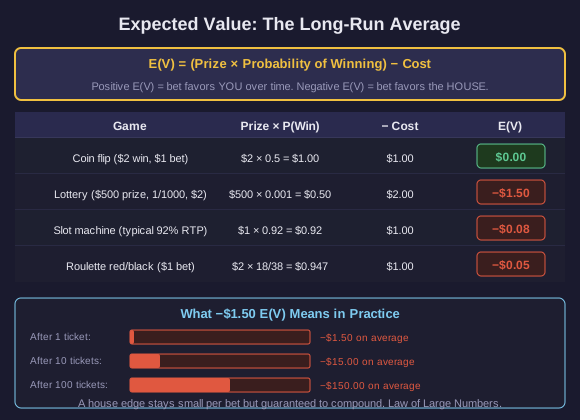
Expected Value
Expected value (EV) is the average outcome you would get if you repeated something many, many times.
The formula is:
E(V) = (prize × probability of winning) - cost
If the expected value is positive, the bet favors you over time.
If the expected value is negative, the bet favors the house over time.
This explains why casinos are profitable. Every game they offer has a negative expected value for the player. One person might win big, but across thousands of bets, the math always favors the house.
Lottery Problem
Let's calculate the expected value of a lottery ticket.
- A ticket costs $2
- The chance of winning is 1 in 1,000
- The prize is $500
Probability in Everyday Life
Probability Is Everywhere
Probability is not just for casinos & card games. It shapes decisions in the real world every day.
Weather forecasts: When the forecast says '70% chance of rain,' it means that in 100 similar weather situations, it rained about 70 times. It does not mean 70% of the area will get rain, or that it will rain for 70% of the day.
Sports analytics: Teams use probability to decide when to go for it on fourth down, when to pull a goalie, or when to bunt. Moneyball was a probability revolution.
Medical testing: This is where probability gets genuinely counterintuitive: & where misunderstanding it can cause real harm.
Medical Test Problem
The False Positive Puzzle
This is one of the most famous problems in probability. Read carefully.
- A disease affects 1 in 1,000 people in the population.
- A test for the disease is 99% accurate: meaning it correctly identifies sick people 99% of the time, & correctly identifies healthy people 99% of the time.
- You take the test & get a positive result.
Most people, including many doctors, get this wrong.
What You Have Learned
Wrapping Up
You have covered a lot of ground in this lesson:
- Basic probability: P(event) = favorable / total
- Compound events: AND means multiply, OR means add
- The Gambler's Fallacy: past results do not affect independent future events
- Expected value: the long-run average outcome of a bet
- Base rates & false positives: why a positive test does not always mean you are sick
Probability is one of the most practical branches of mathematics. It will not make you lucky: but it will help you make better decisions.