Welcome
The ground beneath your feet feels solid. Permanent. Immovable.
It is none of those things.
Right now, as you read this, the ground you are sitting on is moving: slowly, relentlessly, at about the speed your fingernails grow.
Over millions of years, that slow creep has ripped continents apart, built the tallest mountains on Earth, & triggered earthquakes that leveled cities.
Today we will understand the engine that drives all of it.
A Strange Observation
The Man Nobody Believed
In 1912, a German meteorologist named Alfred Wegener noticed something odd: the east coast of South America & the west coast of Africa fit together like puzzle pieces.
He proposed that all the continents were once joined in a single supercontinent he called Pangaea (Greek for 'all lands'), & that they had slowly drifted apart.
Scientists laughed at him. They could not imagine a force powerful enough to move entire continents. Wegener died in 1930 on an expedition in Greenland, never seeing his idea accepted.
It took another 30 years: and new technology that mapped the ocean floor: before the world realized Wegener was right.
What Is Inside the Earth?
Peeling Back the Layers
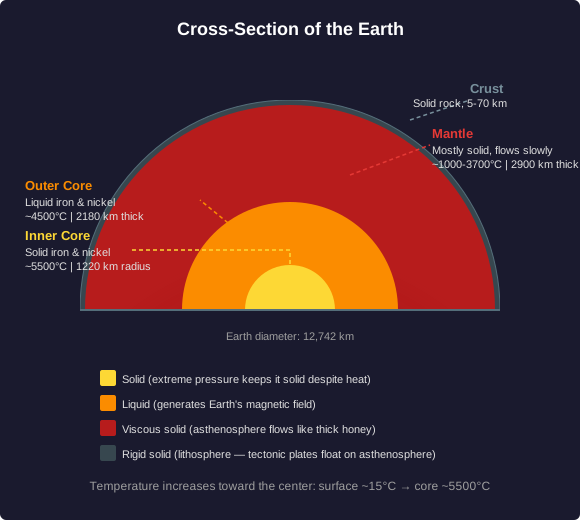
If you could slice the Earth in half, you would see four main layers:
Crust: the outermost layer. It is thin: proportionally thinner than the skin of an apple. Ocean crust is only about 7 km thick. Continental crust averages 35 km. That sounds like a lot, but the Earth is 12,742 km across.
Mantle: below the crust, about 2,900 km thick. It is made of hot, dense rock. The upper mantle is partially molten and flows very slowly: like thick honey heated on a stove. This flowing layer is called the asthenosphere.
Outer core: a layer of liquid iron and nickel, about 2,200 km thick. It is so hot (4,500–5,500°C) that the metal is molten. This flowing metal generates Earth's magnetic field.
Inner core: a solid ball of iron and nickel at the very center, about 1,220 km in radius. It is the hottest part of the Earth: over 5,400°C, hotter than the surface of the Sun.
Broken Shell
A Cracked Eggshell
The Earth's crust is not one continuous shell. It is broken into about 15 major tectonic plates (& many smaller ones) that fit together like a cracked eggshell.
These plates are not thin: they include the crust and the uppermost part of the mantle, together called the lithosphere. The lithosphere is rigid, 70–150 km thick, and it floats on the softer, partially molten asthenosphere beneath it.
Some plates carry continents (continental plates). Some carry ocean floor (oceanic plates). Many carry both.
The largest plate is the Pacific Plate, which is almost entirely oceanic. You are probably sitting on the North American Plate, which stretches from the Mid-Atlantic Ridge all the way to the west coast of the United States.
What Makes Them Move?
Convection: The Engine
Deep in the mantle, the rock near the core is extremely hot. Hot rock is less dense, so it rises. As it approaches the surface, it cools, becomes denser, & sinks back down. This creates a slow, circular flow called a convection current.
Think of a pot of water heating on a stove: water at the bottom heats up, rises, cools at the surface, and sinks again. The mantle does the same thing: except with rock, and incredibly slowly.
These convection currents drag the tectonic plates along like objects floating on a slowly moving conveyor belt.
The process is slow: plates move between 2 and 15 centimeters per year: but over millions of years, it reshapes the entire surface of the planet.
Three Types of Boundaries
Where Plates Meet
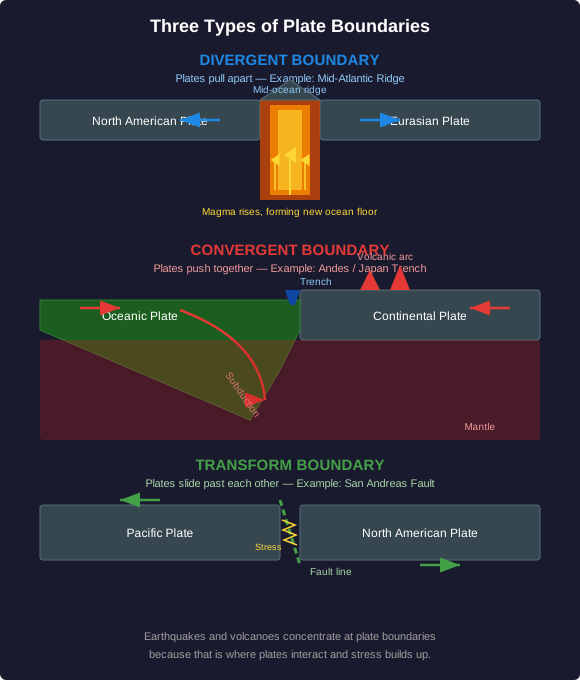
The most dramatic geology on Earth happens where plates meet: at their boundaries. There are three types:
Divergent boundaries: plates move apart. Magma rises from the mantle to fill the gap, creating new crust. The Mid-Atlantic Ridge is a divergent boundary running down the middle of the Atlantic Ocean. Iceland sits right on top of it: you can literally stand on the boundary between the North American Plate and the Eurasian Plate.
Convergent boundaries: plates move toward each other. When an oceanic plate meets a continental plate, the denser oceanic plate dives underneath in a process called subduction. When two continental plates collide, neither subducts: they crumple upward into mountain ranges. The Himalayas formed this way, where the Indian Plate crashed into the Eurasian Plate.
Transform boundaries: plates slide past each other horizontally. The San Andreas Fault in California is a transform boundary where the Pacific Plate and the North American Plate grind past each other. This produces frequent earthquakes.
Growing Mountains
The Himalayas: A Collision in Slow Motion
About 50 million years ago, the Indian Plate: which had been racing northward at a geologically fast speed: slammed into the Eurasian Plate.
Neither plate could subduct under the other because both were continental crust: thick, buoyant, and too light to sink.
So the crust crumpled, buckled, and was pushed upward. The collision created the Himalayas, including Mount Everest: the highest point on Earth at 8,849 meters.
And the collision is not over. The Indian Plate is still pushing into Asia at about 1 centimeter per year, & the Himalayas are still growing.
Ring of Fire
Where Disaster Strikes
If you plot every major earthquake & volcanic eruption on a map, a pattern jumps out immediately: they cluster along plate boundaries.
The most dramatic example is the Ring of Fire: a horseshoe-shaped belt around the Pacific Ocean where the Pacific Plate meets several other plates. About 75% of the world's active volcanoes and 90% of the world's earthquakes occur along the Ring of Fire.
This is not a coincidence. Earthquakes happen when plates suddenly slip past each other, releasing built-up stress. Volcanoes form where magma finds a path to the surface: often at subduction zones, where a sinking plate melts and the molten rock rises.
The Richter scale measures earthquake magnitude: the energy released. Each whole number increase represents about 32 times more energy. A magnitude 7 earthquake releases about 1,000 times more energy than a magnitude 5.
Why Boundaries?
Connecting the Dots
The interior of a tectonic plate is relatively stable. The rock is solid, the plate is moving as one unit, & there is no reason for the crust to crack or melt.
But at boundaries, plates are grinding, pulling apart, or colliding. That is where stress builds up, crust fractures, & magma finds escape routes.
Think of it like a pane of glass: the middle is strong, but the edges & corners are where cracks form.
How Do We Know?
The Evidence Is Everywhere
Wegener proposed continental drift in 1912, but he could not explain the mechanism. Modern evidence has proven him right many times over:
Fossil distribution: identical fossils of Mesosaurus (a freshwater reptile) are found in both Brazil and West Africa, but nowhere else. It could not have swum across the Atlantic. The continents must have been joined.
Matching rock types: mountain chains in Scotland line up perfectly with the Appalachian Mountains in the eastern United States when you push the continents back together. Same rocks, same age, same formation: separated by an ocean.
Glacial scratches: ancient glacial marks found in Africa, India, South America, and Australia all point toward a single ice cap centered on Antarctica: exactly where those continents would have been in Pangaea.
GPS measurements: today, we can measure plate movement directly using GPS satellites. North America moves away from Europe at about 2.5 cm per year. We can watch it happen in real time.
Future Earth
Where Are We Headed?
If the plates keep moving at their current rates, geologists can project where the continents will be in the future.
In about 250 million years, the continents are expected to collide again into a new supercontinent. Scientists have given it various names: Pangaea Ultima, Amasia, or Novopangaea: depending on which model they use.
The Atlantic Ocean will close. Africa will merge with Europe. Australia will drift north into Southeast Asia.
This has happened before. Pangaea was not the first supercontinent: there have been several, going back billions of years. The cycle of splitting and reassembling takes about 400–500 million years. Geologists call it the supercontinent cycle.
What Will You Remember?
The Big Picture
The Earth is not static. It is a dynamic, churning planet: a thin crust floating on a sea of slowly moving rock.
Everything connects: convection currents drive plate movement; plate boundaries produce earthquakes, volcanoes, & mountains; the evidence is written in fossils, rocks, & GPS data.
Alfred Wegener saw the puzzle pieces a century ago. It took the world decades to catch up. Today, plate tectonics is one of the most powerful frameworks in all of science: it explains everything from why Japan has earthquakes to why you can find seashells on mountaintops.