Welcome
Every day, someone is trying to change your mind.
Advertisements tell you what to buy. Politicians tell you what to believe. Your friends try to convince you where to eat lunch.
Persuasion is everywhere: in social media posts, courtroom arguments, newspaper editorials, and even the texts you send when you are trying to get out of doing chores.
In this lesson, you are going to learn how persuasion works and how to write a persuasive essay: a piece of writing designed to change someone's mind.
By the end, you will have the tools to argue like a lawyer & write like a journalist.
Warm-Up
Before We Begin
Think about a time you tried to convince someone of something.
Maybe you argued for a later bedtime, lobbied for a pet, defended your favorite movie, or tried to change a rule you thought was unfair.
What Is a Thesis?
The One Sentence That Drives Everything
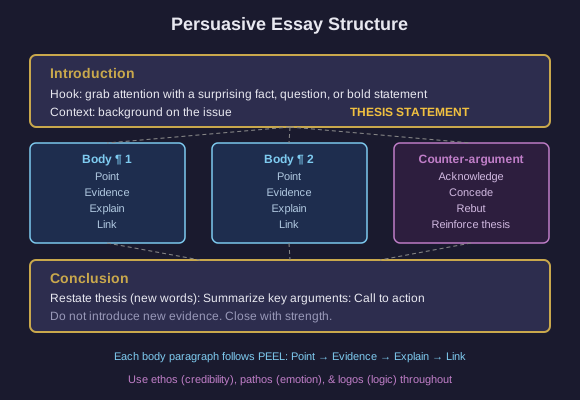
Every persuasive essay begins with a thesis statement: a single sentence that tells the reader exactly what you believe and why.
Your thesis is your claim. It is the hill you are willing to defend.
A strong thesis is:
- Specific: not vague or wishy-washy
- Arguable: someone reasonable could disagree with it
- Clear: the reader knows exactly where you stand
Strong vs. Weak Theses
Weak: School uniforms are a topic that people have different opinions about.
This says nothing. It takes no position.
Weak: School uniforms are bad.
This takes a position but gives no reason. Bad how? For whom?
Strong: Mandatory school uniforms suppress student individuality without improving academic performance, & schools should adopt flexible dress codes instead.
This takes a clear position, gives reasons, & hints at a solution.
Types of Evidence
A Claim Without Evidence Is Just an Opinion
Your thesis makes a promise. Your evidence keeps it.
There are four main types of evidence you can use:
1. Facts and statistics: hard numbers and verified information
According to a 2019 study, schools with uniform policies saw no measurable improvement in test scores.
2. Expert opinions: quotes or findings from credible authorities
Dr. David Brunsma, a sociologist who studied uniforms for over a decade, found no significant effect on behavior or achievement.
3. Anecdotes: real stories that illustrate your point
When my school introduced uniforms, students found other ways to express status: through shoes, phones, and accessories: defeating the stated purpose.
4. Logical reasoning: connecting cause and effect
If the goal of uniforms is to reduce distraction, but students are still distracted by other status symbols, then uniforms do not solve the underlying problem.
The strongest essays use a mix of all four.
PEEL Paragraph
PEEL: The Structure of a Body Paragraph
Each body paragraph in a persuasive essay should follow the PEEL structure:
- P: Point: State the argument this paragraph makes (one clear sentence)
- E: Evidence: Provide a fact, quote, example, or statistic that supports it
- E: Explain: Tell the reader WHY this evidence matters and HOW it supports your thesis
- L: Link: Connect back to your thesis or transition to the next point
Example PEEL paragraph:
School uniforms fail to achieve their primary goal of reducing social division. (Point) A 2015 study published in the Journal of School Violence found that bullying rates were actually slightly higher in schools with mandatory uniforms. (Evidence) This suggests that uniforms do not eliminate social hierarchies: they merely shift the markers of status from clothing to other visible indicators like shoes, backpacks, and electronics. (Explain) Rather than enforcing surface-level sameness, schools should invest in anti-bullying programs that address the root causes of social division. (Link)
Acknowledging the Other Side
Why You Should Argue Against Yourself
This might sound strange, but the best persuasive essays include the opposing viewpoint.
Why? Because acknowledging the other side shows that you have thought carefully about the issue. It makes you look fair, informed, and confident: not afraid of disagreement.
Ignoring counterarguments makes your essay look one-sided. Addressing them makes it bulletproof.
The Formula
A counterargument paragraph follows a pattern:
1. Acknowledge: Some argue that... / Critics claim that... / It is true that...
2. Concede (optional): While this concern is understandable...
3. Rebut: However, this argument overlooks... / Nevertheless, the evidence shows...
Example:
Some argue that school uniforms promote equality by ensuring all students dress the same regardless of income. While this concern about economic disparity is valid, uniforms merely relocate status markers rather than eliminating them. Students still signal wealth through shoes, electronics, & accessories. A more effective approach would be addressing economic inequality directly rather than masking it with identical shirts.
Ethos, Pathos, Logos
The Three Ancient Tools of Persuasion
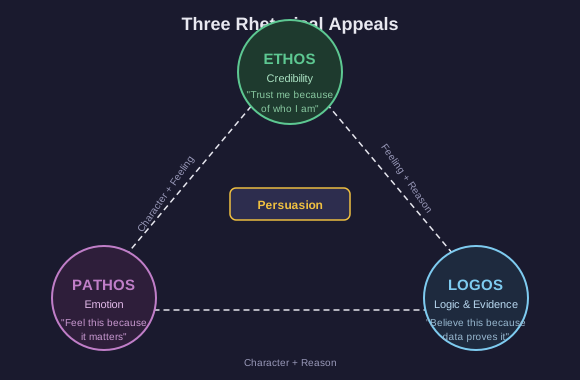
Over 2,000 years ago, the Greek philosopher Aristotle identified three ways to persuade an audience. Writers & speakers still use them today.
Ethos: Appeal to credibility
Why should the audience trust you? Ethos comes from expertise, character, & fairness.
As a student who has attended schools with & without uniforms, I have seen both sides firsthand.
Pathos: Appeal to emotion
What does the audience feel? Pathos uses vivid language, stories, & imagery to stir emotions.
Imagine a child standing at the school gates, ashamed of the only shirt she owns: and now imagine every student wearing the same one.
Logos: Appeal to logic
What does the evidence prove? Logos uses facts, statistics, & logical reasoning.
If 70% of students report that uniforms have no effect on their sense of belonging, the policy is failing its stated goal.
Martin Luther King Jr.'s 'I Have a Dream'
One of the greatest persuasive speeches in history uses all three:
- Ethos: King speaks as a minister, a leader, & a moral authority
- Pathos: I have a dream that my four little children will one day live in a nation where they will not be judged by the color of their skin but by the content of their character
- Logos: He references the Constitution, the Declaration of Independence, & the unfulfilled promise of equality
The most powerful persuasion uses all three appeals together.
Identify the Appeal
Practice: Spot the Technique
Read the following passage & decide which rhetorical appeal it primarily uses.
According to the National Center for Education Statistics, schools that implemented uniform policies between 2010 & 2018 showed no statistically significant change in dropout rates, attendance, or standardized test scores across any demographic group.
Write Your Opening
Put It All Together
You now have everything you need to write the opening paragraph of a persuasive essay.
A strong opening paragraph does three things:
1. Hook: Grab the reader's attention with a surprising fact, a provocative question, a vivid image, or a bold statement
2. Context: Give the reader enough background to understand the issue
3. Thesis: End with your thesis statement, the claim you will spend the rest of the essay defending
Example:
Every morning, 20 million American students put on the same outfit as every other student in their school. They are told this will make them equal. But equality is not a shirt: it is a set of opportunities, resources, and choices. Mandatory school uniforms create the illusion of fairness while doing nothing to address the real inequalities students face, and schools should redirect uniform budgets toward programs that genuinely support student success.
Notice how the example moves from hook (the image of 20 million students) to context (the promise of equality) to thesis (uniforms create an illusion).