Welcome
Today we will talk about food: but not in the way you usually hear about it.
No guilt. No fads. No miracle diets.
Food is three things at once: it is fuel (energy to move & think), building material (your body is constantly rebuilding itself), & information (chemical signals that tell your cells what to do).
Most nutrition advice on the internet treats food as just one of those things. That is where the confusion starts.
By the end of this lesson, you will understand what food actually does inside you: & why the best approach to eating is simpler than the internet makes it seem.
Warm-Up
Quick Check-In
Before we start, let's just notice something.
Big Three
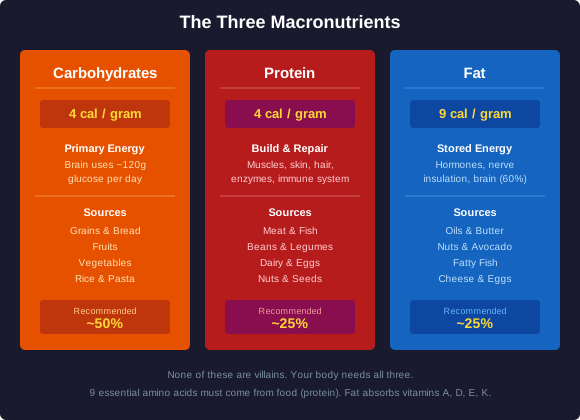
Macronutrients: The Big Three
Everything you eat comes from three main building blocks, called macronutrients (macro = large). Your body needs all three.
Carbohydrates: Your body's preferred energy source. Bread, rice, fruit, vegetables, sugar, all carbs. Your brain alone uses about 120 grams of glucose (a carb) per day.
Protein: Building & repair material. Your muscles, skin, hair, enzymes, & immune system are all built from protein. Protein comes from smaller units called amino acids, your body can make some, but nine 'essential' amino acids must come from food.
Fat: Not the enemy. Fat makes hormones, insulates your nerves, protects your organs, & is essential for brain function. Your brain is about 60% fat by dry weight. Fat also helps you absorb vitamins A, D, E, & K.
None of these are villains. Every decade, popular culture picks one to demonize: fat in the 1990s, carbs in the 2010s. The science has not changed: you need all three.
Why Athletes Need More
Protein & Physical Demand
When you exercise hard, you create tiny tears in your muscle fibers. That sounds bad, but it is actually how muscles grow: your body repairs the tears & makes the fibers slightly stronger.
This repair process requires amino acids from protein.
Vitamins and Minerals
Micronutrients: Small Amounts, Big Impact
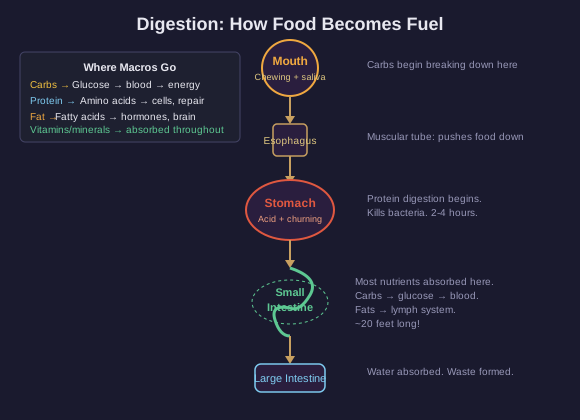
Macronutrients are the bulk of what you eat. Micronutrients, vitamins & minerals, are needed in tiny amounts, but without them, your body breaks down.
Iron: Carries oxygen in your blood. Without enough iron, your cells are starved of oxygen & you feel exhausted. We call this anemia.
Calcium: Builds & maintains bones & teeth. Your body also uses calcium for muscle contraction & nerve signaling. If you do not get enough from food, your body pulls it from your bones.
Vitamin D: Supports your immune system & helps absorb calcium. Most people are deficient because we get it primarily from sunlight, & modern life happens mostly indoors.
Vitamin C: Supports immune function & is essential for making collagen (the protein that holds your skin, tendons, & blood vessels together). Humans are one of the few mammals that cannot make their own vitamin C, we must get it from food.
Scurvy Problem
A Historical Puzzle
For centuries, sailors on long ocean voyages would develop a terrifying disease. Their gums would bleed, their teeth would fall out, old wounds would reopen, & they would eventually die.
This disease is called scurvy, & it killed more sailors than storms, battles, & all other diseases combined.
Calories In, Calories Out
Energy Balance: Real but Oversimplified
You have probably heard the phrase calories in, calories out: the idea that if you eat more energy than you burn, you gain weight, & if you eat less, you lose weight.
This is technically true. It is the first law of thermodynamics applied to biology. Energy cannot appear from nowhere or vanish.
But it is also deeply misleading as practical advice, because it treats the body like a simple furnace. Your body is not a furnace.
Metabolism varies. Two people of the same size can have basal metabolic rates that differ by 200-300 calories per day. Genetics, muscle mass, sleep, stress, & hormones all play a role.
Not all calories behave the same. 200 calories of broccoli & 200 calories of candy have identical energy, but wildly different effects on your blood sugar, satiety, & nutrient intake.
Processed food is engineered. Food companies employ scientists to find the 'bliss point': the combination of sugar, salt, & fat that maximizes craving & minimizes satiety. This is not a conspiracy theory; it is standard industry practice documented in public research.
Reading Nutrition Labels
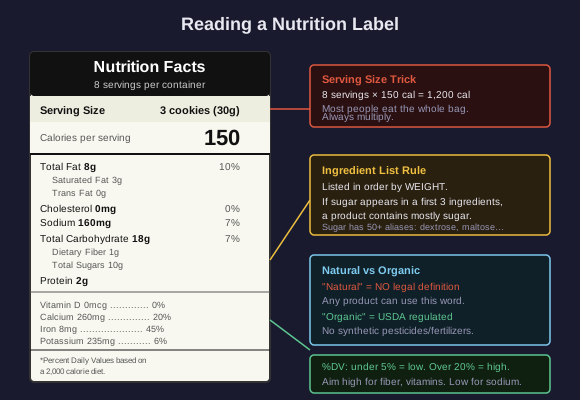
Food Labels: What They Show & What They Hide
The nutrition label on packaged food is one of the most useful tools you have: if you know how to read it.
Serving size: This is where companies get tricky. A bottle of soda might list 100 calories per serving, but the bottle contains 2.5 servings. Most people drink the whole bottle.
Ingredient list: Ingredients are listed in order of weight, most to least. If sugar (or one of its 50+ aliases: high fructose corn syrup, dextrose, maltose, etc.) is in the first three ingredients, that product is mostly sugar.
'Natural': This word has no legal definition when used on food labels in the United States. Any product can call itself natural. It is pure marketing.
'Organic': This word does have a legal definition. USDA Organic means the food was produced without synthetic pesticides, synthetic fertilizers, or GMOs, & was inspected. It does not automatically mean healthier, but it does mean something specific.
The gap between 'natural' (meaningless) & 'organic' (regulated) is a good example of why reading critically matters.
Eat Food, Not Too Much, Mostly Plants
Cutting Through the Noise
Writer Michael Pollan spent years reviewing nutrition research & condensed it into seven words:
Eat food. Not too much. Mostly plants.
Eat food: meaning real food, not heavily processed products with ingredient lists you cannot pronounce. If your great-grandmother would not recognize it as food, be skeptical.
Not too much: meaning pay attention to hunger & fullness signals. Processed food is designed to override these signals, so eating more whole foods naturally helps with portion awareness.
Mostly plants, meaning fruits, vegetables, legumes, nuts, & grains should be the base of your diet. This is not a vegan argument, it is what the evidence consistently shows across cultures & decades of research.
That is it. Not a $200 meal plan. Not a supplement stack. Not a detox. Seven words backed by decades of nutritional science.
What Will You Remember?
Wrapping Up
Here is what you covered today:
- Food is fuel, building material, & information
- Carbs, protein, & fat are all essential: none are villains
- Micronutrients like iron, calcium, vitamin D, & vitamin C are needed in small amounts but have massive effects
- 'Calories in, calories out' is real physics but oversimplified biology
- Food labels are designed to sell, not to educate: read them critically
- The best nutrition advice fits in seven words: eat food, not too much, mostly plants
Nutrition science is real science. But the nutrition industry is marketing. Learning to tell the difference is one of the most practical skills you can develop.