Welcome
In 1687, a man named Isaac Newton published a book that changed everything.
It was called Principia Mathematica, and in it he laid out three simple laws that explain how objects move: from a rolling ball to a rocket leaving Earth.
Newton did not discover gravity by getting hit on the head with an apple. That is a myth. What he actually did was far more impressive: he saw what everyone else saw: things falling: and asked why.
By the end of this lesson, you will understand the three laws that govern every push, pull, crash, & orbit in the universe.
Warm-Up
Before We Begin
Let's start with something you have experienced every day of your life.
Objects Resist Change
Newton's First Law
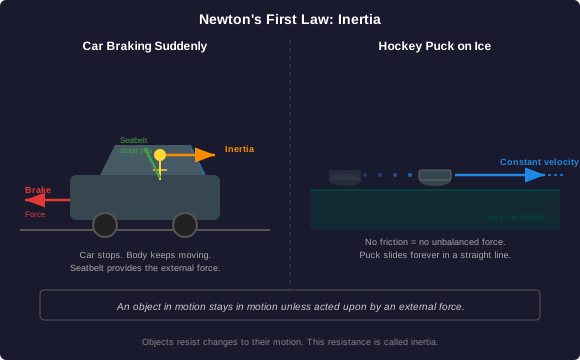
An object at rest stays at rest, and an object in motion stays in motion at the same speed and in the same direction: unless acted on by an unbalanced force.
This property is called inertia. Everything in the universe resists having its motion changed.
A book sitting on a table will sit there forever unless something pushes it. A hockey puck sliding on frictionless ice would slide forever in a straight line unless something stops it.
This was revolutionary. Before Newton, people assumed that objects naturally slow down. Newton realized that slowing down is not natural: it only happens because of forces like friction and air resistance.
Inertia in Everyday Life
You Experience Inertia Every Day
Seatbelts exist because of inertia. When a car stops suddenly, you do not stop with the car: your body keeps moving forward at the car's original speed. The seatbelt is the unbalanced force that stops you.
The tablecloth trick works because of inertia. The plates are at rest & resist being moved. If you pull the cloth fast enough, friction does not have time to accelerate the plates, & they stay put.
A soccer ball on the ground stays perfectly still until someone kicks it. It has no desire to move, no tendency to move. It is completely indifferent.
Force Equals Mass Times Acceleration
Newton's Second Law
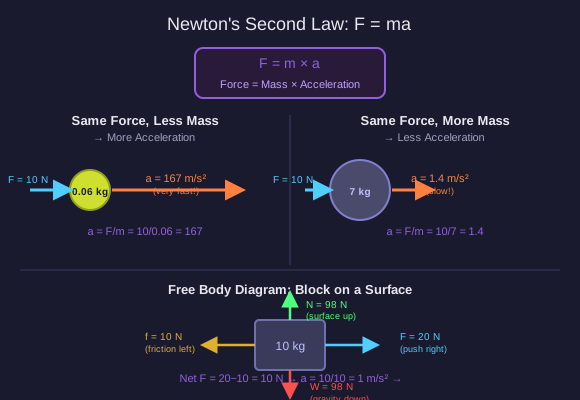
Force equals mass times acceleration: F = ma
This is the most useful equation in all of physics. It tells you three things at once:
1. The more force you apply to an object, the more it accelerates (speeds up, slows down, or changes direction).
2. The more mass an object has, the less it accelerates for the same force.
3. If you know any two of the three values: force, mass, or acceleration: you can calculate the third.
Mass is how much matter an object contains. It gets measured in kilograms.
Acceleration is how quickly velocity changes. It gets measured in meters per second squared (m/s²).
Force is measured in Newtons (N): yes, the unit is named after him.
Applying F = ma
Pushing Carts
Think about this scenario: you are at a grocery store. You push an empty shopping cart, & it rolls easily. Then you fill the cart with heavy groceries & push with the same force.
Every Action Has an Equal Opposite Reaction
Newton's Third Law
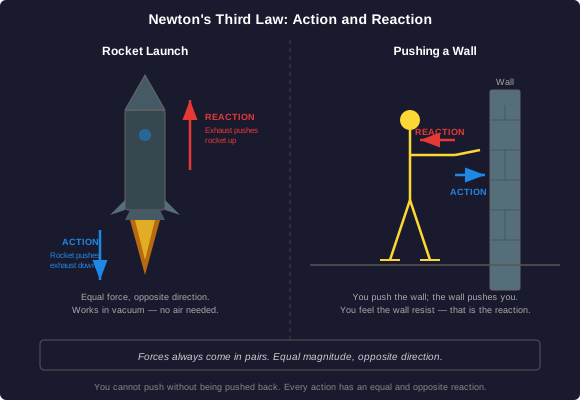
For every action, there is an equal & opposite reaction.
This means that forces always come in pairs. You cannot push without being pushed back.
When you walk, your foot pushes backward on the ground, & the ground pushes forward on you. That forward push is what moves you.
When a rocket launches, it does not push against the ground or the air. It throws hot gas downward at tremendous speed, and the gas pushes back on the rocket with equal force: upward.
When you swim, your hands push water backward, & the water pushes you forward.
The forces are always equal in size & opposite in direction. Always.
Jumping on the Earth
A Mind-Bending Question
When you jump, your legs push down on the Earth. By Newton's Third Law, the Earth pushes up on you with an equal force: that is what launches you into the air.
But here is the strange part: if you push down on the Earth, & the Earth pushes up on you, then the forces are equal. You fly upward. So the Earth should move downward.
Universal Gravitation
Newton's Law of Universal Gravitation
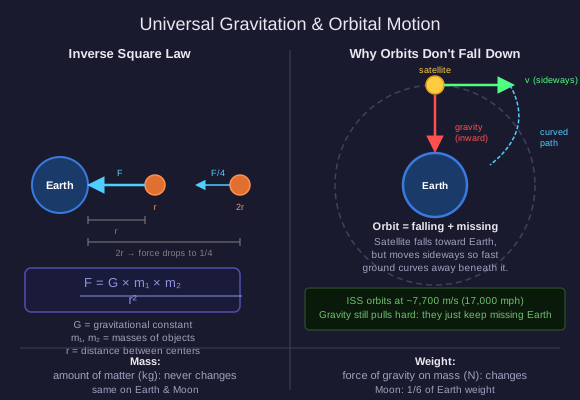
Newton realized that the same force that makes an apple fall from a tree is the same force that keeps the Moon orbiting the Earth.
Every object with mass attracts every other object with mass. The strength of the attraction depends on two things:
1. Mass: more massive objects pull harder.
2. Distance: objects farther apart pull weaker. The force drops off with the square of the distance: twice as far means one-quarter the pull.
Weight vs. Mass
Mass is the amount of matter in you. It does not change no matter where you are.
Weight is the force of gravity pulling on your mass. It changes depending on where you are.
On the Moon, you have the same mass but one-sixth the weight, because the Moon's gravity is weaker.
Why Doesn't the Moon Fall?
It is falling: constantly. But it is also moving sideways so fast that by the time it falls a little, the Earth's surface has curved away beneath it. It keeps falling and keeps missing. That is what an orbit is: falling and missing the ground forever.
Weightless but Not Gravity-Free
The Space Station Puzzle
Astronauts on the International Space Station float around as if they are weightless. You have probably seen the videos: they tumble, water forms floating blobs, and nothing falls.
Here is the surprising fact: the ISS orbits about 400 km above Earth. At that altitude, gravity is still about 90% as strong as it is on the surface.
Newton's Laws in the Real World
Forces in Engineering & Sports
Every structure, vehicle, & sport on Earth obeys Newton's laws.
Bridges must balance all forces to stay still (First Law). Engineers calculate the weight of traffic (Second Law) & ensure every support pushes back with equal force (Third Law).
Rockets work purely by the Third Law: throwing mass in one direction to accelerate in the other. There is no air to push against in space. The exhaust goes down; the rocket goes up.
Sports are applied physics. A baseball bat transfers force to a ball (Second Law). A sprinter pushes backward on the starting blocks & the blocks push them forward (Third Law). A hockey puck slides across ice with minimal friction, demonstrating the First Law.
Every time an engineer designs a car, a bridge, or a spacecraft, they are solving Newton's equations.
Physics in Your Favorite Sport
Your Turn
Now apply what you have learned.