Welcome
Music is organized sound.
That might sound too simple, but it is the truest definition there is. A composer or songwriter takes raw sound: vibrations in the air: and organizes it into patterns that make us feel something.
And here is the thing most people forget: silence is part of music too. The pause between notes, the breath before a chorus, the moment of quiet before the beat drops: silence gives sound its shape.
Every song you have ever loved is built from the same small set of building blocks: rhythm, melody, & harmony. Today we will take those blocks apart, look at how they work, & put them back together.
Warm-Up
Before We Begin
Think of a song you know by heart. Not just one you like: one you could hum right now without looking up the words.
What Is Rhythm?
The Heartbeat of Music
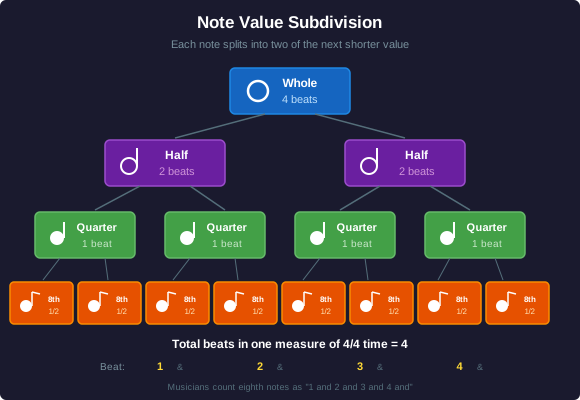
Rhythm is the pattern of sounds and silences in time. It is the most fundamental element of music: you can have rhythm without melody (think of a drum circle), but you cannot have melody without rhythm.
Three key concepts:
Beat: the steady pulse underneath the music. When you tap your foot to a song, you are feeling the beat.
Tempo: how fast or slow the beat goes. A lullaby has a slow tempo. A punk song has a fast one. Tempo is measured in BPM (beats per minute).
Time signature: how beats are grouped. This is where it gets interesting.
Time Signatures
Counting Time
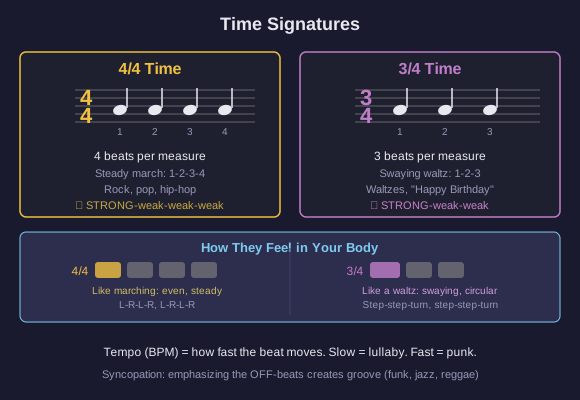
A time signature is two numbers stacked on top of each other at the beginning of a piece of music.
4/4 time: four beats per measure. This is the most common time signature in popular music. Rock, pop, hip-hop, country: almost all of it is in 4/4. Count along: 1-2-3-4, 1-2-3-4. It feels steady and natural.
3/4 time: three beats per measure. This is waltz time. Count along: 1-2-3, 1-2-3. It has a swaying, circular feel: think of a music box or a waltz.
6/8 time: six beats per measure, grouped in twos. It has a rolling, swinging feel. Many Irish jigs and ballads use 6/8. Count along: 1-2-3-4-5-6, with emphasis on 1 and 4.
Syncopation: when the rhythm emphasizes the off-beats instead of the strong beats. It creates surprise and groove. Funk, jazz, and reggae are full of syncopation.
What Is Melody?
The Part You Sing
Melody is a sequence of pitches arranged in time. It is the part of a song you hum, whistle, or sing in the shower.
To understand melody, we need to understand a few things about pitch.
Pitch: how high or low a note sounds. A piccolo plays high pitches. A tuba plays low pitches. Pitch is determined by the frequency of sound vibrations.
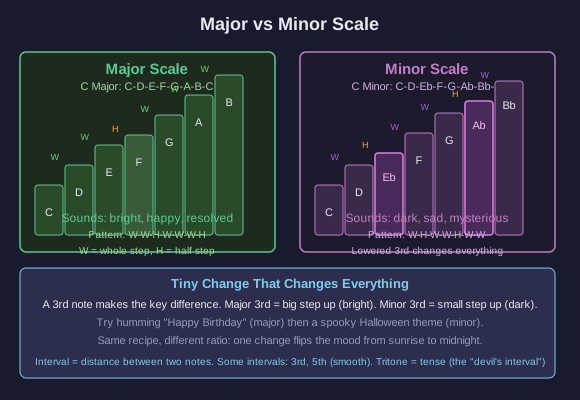
Scales: a set of pitches arranged in order from low to high. Think of a staircase of notes. The two most important scales are:
- Major scale: sounds bright, happy, and resolved. Think of Do-Re-Mi-Fa-Sol-La-Ti-Do from The Sound of Music. That is a major scale.
- Minor scale: sounds darker, sadder, more mysterious. Same notes, but starting from a different place, which changes the pattern of steps between them.
Intervals: the distance between two notes. Some intervals sound smooth and pleasant (a third, a fifth). Others sound tense and unstable (a tritone: the 'devil's interval' that was banned in medieval church music).
What Is Harmony?
Notes Together
Melody is one note at a time. Harmony is what happens when you play three or more notes at the same time.
A group of notes played together is called a chord.
Consonance: when notes sound smooth and stable together. A major chord (like C-E-G) is consonant. It sounds resolved, complete, at rest.
Dissonance: when notes sound tense, clashing, or unstable together. Dissonance is not bad: it creates tension that makes the resolution feel satisfying. Horror movie soundtracks are full of dissonance. So is jazz.
Chord progressions: a series of chords played in sequence. This is the backbone of a song.
The most common chord progression in Western music is I-IV-V-I (one-four-five-one). In the key of C, that would be C major, F major, G major, C major.
This single progression: or close variations of it: is in thousands of songs: 'Twist and Shout,' 'La Bamba,' 'Wild Thing,' 'Louie Louie,' and countless others.
When you hear a song and it sounds 'right': like the chords are going where you expect: that is a chord progression doing its work.
Song Form
How Songs Are Built
Most songs are not random: they follow a structure, a blueprint.
Verse: the part where the story unfolds. The melody stays the same, but the words change each time. Verses give you new information.
Chorus: the part that repeats with the same words and melody every time. The chorus is the emotional core of the song: it is the part everyone sings along to.
Bridge: a contrasting section that appears once, usually after the second chorus. It breaks the pattern and gives the ear something new before the final chorus hits.
The most common pop structure is: Verse - Chorus - Verse - Chorus - Bridge - Chorus
But structure goes deeper than pop songs:
- ABA form (also called ternary form): a section, a contrasting section, then a return to the first. Many classical pieces and jazz standards use this.
- 12-bar blues: a specific 12-measure chord progression (I-I-I-I, IV-IV-I-I, V-IV-I-I) that is the foundation of blues, early rock and roll, and jazz.
Repetition & Surprise
Here is the secret: repetition creates expectation. Surprise creates emotion.
When a chorus repeats, your brain learns to expect it. When the bridge breaks the pattern, it feels fresh. When the chorus returns after the bridge, it feels like coming home. Songwriters use this tension between the familiar & the unexpected to make you feel things.
Active Listening
Putting It All Together
You now have vocabulary for talking about music in a way most people cannot.
You know about:
- Rhythm: beat, tempo, time signature, syncopation
- Melody: pitch, scales, major and minor keys, intervals
- Harmony: chords, consonance and dissonance, chord progressions
- Structure: verse, chorus, bridge, ABA form, 12-bar blues
Now it is time to use it.
Pick any song: one you love, one that is playing right now, or one you have always been curious about. Listen to it (or replay it in your head) and try to hear it with your new ears.