Welcome
Welcome to Logic and Critical Thinking: the oldest intellectual toolkit in the world.
The word philosophy comes from the Greek philosophia, which means love of wisdom. Not possession of wisdom: love of it. The difference matters.
Philosophy does not hand you answers. It teaches you how to ask better questions, spot bad reasoning, & build arguments that actually hold together.
First Troublemaker
Socrates: The Original Critical Thinker
About 2,400 years ago in Athens, a stonemason named Socrates wandered around the marketplace asking people uncomfortable questions.
A general claimed to know what courage was: Socrates asked questions until the general contradicted himself. A priest claimed to know what piety was: same result.
Socrates said he was the wisest man in Athens, but only because he knew that he did not know. Everyone else thought they had the answers.
The city of Athens eventually put him on trial for 'corrupting the youth': which really meant he was teaching young people to question authority.
They sentenced him to death. He drank the hemlock willingly. He could have escaped, but he said that would contradict everything he taught.
Critical thinking has always made powerful people nervous.
Structure of an Argument
What Is an Argument?
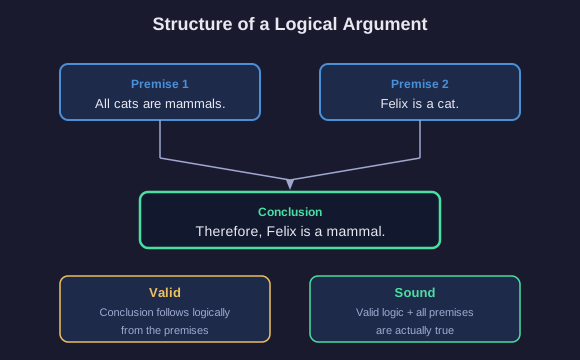
In philosophy, an argument is not a shouting match. It is a structured chain of reasoning.
Every argument has two parts:
1. Premises: statements you assume or claim to be true
2. Conclusion: the statement that follows from the premises
Here is a classic example:
- Premise 1: All cats are mammals.
- Premise 2: Felix is a cat.
- Conclusion: Therefore, Felix is a mammal.
If the premises are true & the logic connects them properly, the conclusion must be true. That is the power of a good argument.
Valid vs Sound
Valid & Sound
Two critical terms:
Valid means the conclusion follows logically from the premises: the structure works, regardless of whether the premises are actually true.
Sound means the argument is valid & all the premises are actually true.
Example of a valid but unsound argument:
- Premise 1: All fish can fly.
- Premise 2: A salmon is a fish.
- Conclusion: Therefore, a salmon can fly.
The logic is perfect: if the premises were true, the conclusion would have to be true. But premise 1 is false, so the argument is valid but not sound.
Now consider this argument:
What Is a Fallacy?
Logical Fallacies: Broken Arguments That Sound Convincing
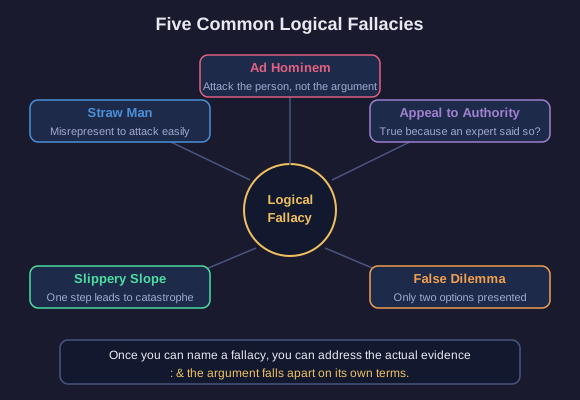
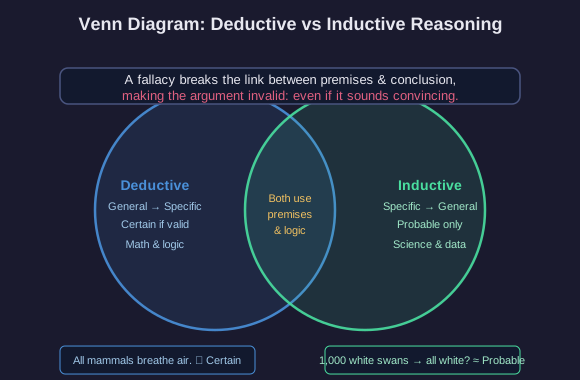
A fallacy is an error in reasoning that makes an argument invalid: but often sounds persuasive.
Fallacies are everywhere: in politics, advertising, social media arguments, & dinner table debates. Once you learn to spot them, you cannot unsee them.
Here are five of the most common:
1. Ad Hominem: attacking the person instead of their argument.
'You cannot trust her research because she is funded by a corporation.' (The funding source might be relevant, but it does not automatically invalidate the research.)
2. Straw Man: misrepresenting someone's argument to make it easier to attack.
'She said we should reduce military spending.' → 'So you want to leave us completely defenseless?'
3. Appeal to Authority: assuming something is true just because an authority figure said it.
'This diet works because a famous actor endorses it.' (Actors are not nutritionists.)
4. Slippery Slope: claiming that one step will inevitably lead to an extreme outcome, without evidence for the chain of events.
'If we allow students to use calculators, soon they will not be able to do any math at all.'
5. False Dilemma: presenting only two options when more exist.
'You are either with us or against us.' (You could be neutral, partially agree, or have a completely different position.)
Spot the Fallacy
Your Turn
Now that you know the five fallacies, let's see if you can spot one in action.
Two Ways of Thinking
Deductive & Inductive Reasoning
There are two fundamentally different ways to build an argument.
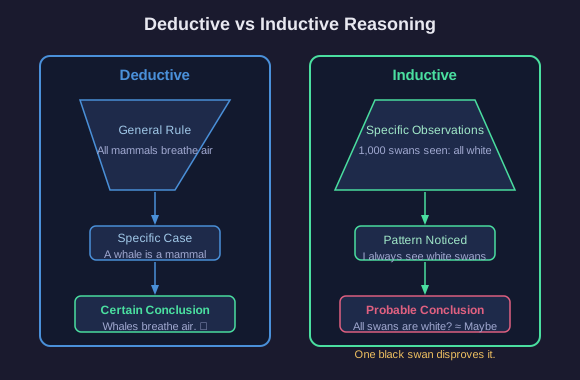
Deductive reasoning moves from general to specific. If the premises are true, the conclusion is certain.
- All mammals breathe air.
- A whale is a mammal.
- Therefore, a whale breathes air.
Inductive reasoning moves from specific to general. The conclusion is probable, but never 100% certain.
- Every swan I have ever seen is white.
- Therefore, all swans are probably white.
Science relies heavily on inductive reasoning: we observe patterns and form theories. But inductive conclusions can always be overturned by new evidence.
In fact, the swan example is famous in philosophy. Europeans believed all swans were white for centuries: until they discovered black swans in Australia in 1697.
Swan Problem
The Swan Problem
Consider this claim:
'I have seen 1,000 white swans. Therefore, all swans are white.'
Thinking Without a Laboratory
Thought Experiments
Philosophers do not have laboratories or telescopes. Their tool is the thought experiment: an imaginary scenario designed to test an idea by pushing it to its limits.
Here are three of the most famous:
The Trolley Problem: A runaway trolley is heading toward five people tied to the tracks. You are standing next to a lever that can divert it to a side track, where only one person is tied. Do you pull the lever? You save five, but you directly cause one death.
The Ship of Theseus: An ancient ship is preserved in a museum. Over the years, every plank is replaced as it rots. Once every original piece is gone, is it still the same ship? What if someone built a second ship from all the discarded planks?
Plato's Cave: Imagine prisoners chained inside a cave since birth, facing a wall. Behind them, a fire casts shadows of objects onto the wall. The shadows are all they have ever seen. They believe the shadows are reality. If one prisoner is freed and sees the real world, would the others believe them when they returned?
Trolley Problem
Your Turn: The Trolley Problem
This is the most debated thought experiment in modern philosophy.
There is no 'right answer': but there are better and worse arguments.
Two major philosophical traditions disagree:
- Utilitarianism says pull the lever: five lives saved is better than one, and the math is simple.
- Deontological ethics says there is a difference between allowing harm and causing it: pulling the lever makes you a killer, even if more people survive.
Philosophy in the Wild
Spotting Bad Arguments in Real Life
Everything you have learned today: argument structure, validity, fallacies, deductive and inductive reasoning: exists for one purpose: to help you think clearly in the real world.
Bad arguments are everywhere:
- News headlines that present false dilemmas
- Social media posts that use ad hominem attacks instead of addressing evidence
- Advertisements that appeal to authority (celebrity endorsements) or use slippery slopes (buy this or your life will fall apart)
- Political speeches that build straw men of their opponents' positions
You now have the vocabulary to name what you see & the tools to evaluate whether an argument actually holds together.
What Will You Remember?
One Last Thought
Socrates believed the unexamined life is not worth living. That sounds dramatic: but his point was simple: if you do not think carefully about what you believe and why, other people will do your thinking for you.
Today you learned to break arguments into premises & conclusions, to tell valid from sound, to name five common fallacies, to distinguish deductive from inductive reasoning, & to wrestle with questions that have no easy answers.
Those are not just school skills. Those are life skills.