Welcome
Algebra is detective work.
Someone has hidden a number. They have given you clues. Your job is to figure out what that number is.
The hidden number gets a name: x. That is all a variable is: a name for something you do not know yet.
By the end of this lesson, you will be able to find x in increasingly tricky hiding spots. And once you can do that, you have the master key to all higher mathematics.
Warm-Up
A Quick Puzzle
Forget math class for a second. Just think about this:
If 3 bags of apples weigh 12 pounds total, how much does one bag weigh?
Balance
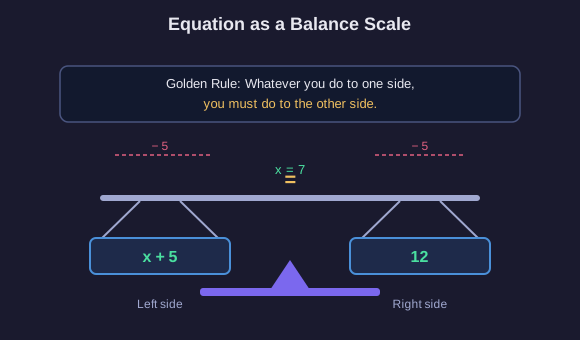
The Balance Metaphor
An equation is a balance scale. The equals sign is the fulcrum. Whatever is on the left weighs the same as whatever is on the right.
The golden rule: whatever you do to one side, you must do to the other. If you add 5 to the left, you add 5 to the right. If you divide the left by 3, you divide the right by 3.
Example 1: x + 5 = 12
The x has 5 added to it. To isolate x, we do the inverse operation: subtract 5 from both sides.
x + 5 - 5 = 12 - 5
x = 7
Example 2: 3x = 21
The x is multiplied by 3. To isolate x, we do the inverse: divide both sides by 3.
3x ÷ 3 = 21 ÷ 3
x = 7
Addition ↔ Subtraction. Multiplication ↔ Division. These are inverse pairs.
Order Matters
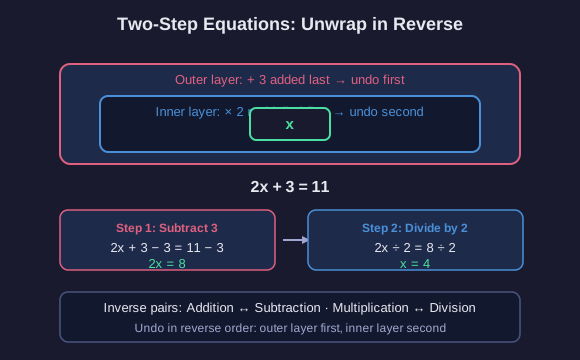
Two Steps to Freedom
Now x is locked behind two operations instead of one.
Example: 2x + 3 = 11
Think of it as unwrapping a package. The x was first multiplied by 2, then had 3 added. To undo this, we go in reverse order:
Step 1: Undo the addition. Subtract 3 from both sides.
2x + 3 - 3 = 11 - 3
2x = 8
Step 2: Undo the multiplication. Divide both sides by 2.
2x ÷ 2 = 8 ÷ 2
x = 4
The rule: undo addition or subtraction first, then undo multiplication or division. You are peeling off layers in reverse order.
You can always check your answer by plugging it back in: 2(4) + 3 = 8 + 3 = 11. ✓
Collecting Variables
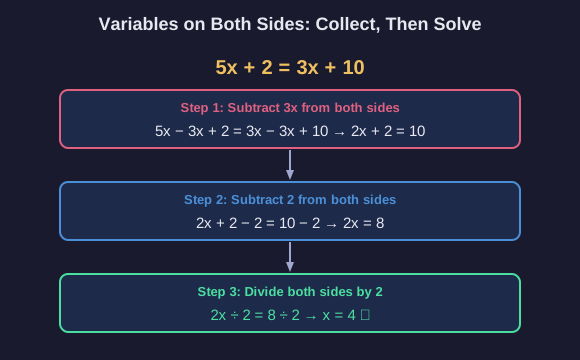
What If x Is on Both Sides?
Up to now, x only appeared on one side of the equation. But what happens when x shows up on both sides?
Example: 5x + 2 = 3x + 10
The x is on both the left & the right. We need to collect all the x terms on one side.
Step 1: Subtract 3x from both sides to move the x terms together.
5x - 3x + 2 = 3x - 3x + 10
2x + 2 = 10
Step 2: Now it is a two-step equation. Subtract 2 from both sides.
2x = 8
Step 3: Divide both sides by 2.
x = 4
Check: 5(4) + 2 = 22. And 3(4) + 10 = 22. Both sides equal 22. ✓
The new move is simple: subtract the smaller x term from both sides to get all the x on one side. Then solve as before.
Translating English to Algebra
From Words to Equations
The hardest part of algebra is not solving equations: it is setting them up. Real problems come in words, not symbols.
The translation guide:
- a number → x
- doubled or twice → 2x
- plus, more than, increased by → +
- minus, less than, decreased by → -
- is, equals, results in → =
Example
"A number doubled plus three equals fifteen."
Translation: 2x + 3 = 15
Solve: 2x = 12, so x = 6.
The trick is to read slowly, translate piece by piece, & write the equation before you try to solve it.
Equations Draw Lines
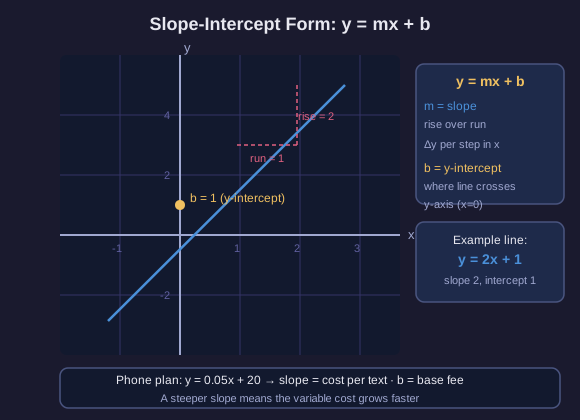
Every Linear Equation Is a Line
You have been solving equations: finding where x lands on a number line. But there is a bigger picture.
When you have an equation with two variables, like y = 2x + 3, every solution is a point on a graph. And all those points form a straight line.
The Slope-Intercept Form: y = mx + b
- m is the slope: how steep the line is. It tells you how much y changes when x increases by 1.
- b is the y-intercept: where the line crosses the y-axis. It is the value of y when x = 0.
Back to the Phone Plan
Your phone plan was: cost = 0.05 × (number of texts) + 20
Or in slope-intercept form: y = 0.05x + 20
- The slope is 0.05: every additional text adds 5 cents to your bill.
- The y-intercept is 20: even with zero texts, you pay $20.
If you graphed this, you would see a line starting at $20 on the y-axis, rising gently by 5 cents for each text.