Congruent vs. Similar
Two Ways Shapes Can Be Related
In geometry, two figures can be related in two important ways:
Congruent (≅) means the figures have the same shape AND the same size. Every side & every angle matches exactly. If you cut one out & placed it on top of the other, they would line up perfectly.
Similar (~) means the figures have the same shape but different sizes. All their angles are equal, but the sides are proportional: one figure is a scaled-up or scaled-down version of the other.
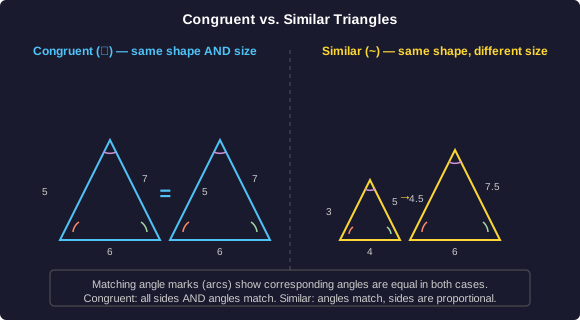
Think of it this way: a photocopy at 100% produces a congruent copy. A photocopy at 150% produces a similar copy: same shape, bigger size.
Triangle Congruence Tests
Proving Triangles Are Congruent
A triangle has 6 measurements: 3 sides & 3 angles. But you do not need all 6 to prove two triangles are congruent. There are shortcuts:
SSS (Side-Side-Side): If all three sides of one triangle equal all three sides of another, the triangles are congruent.
SAS (Side-Angle-Side): If two sides and the included angle (the angle between those two sides) are equal, the triangles are congruent.
ASA (Angle-Side-Angle): If two angles and the included side (the side between those two angles) are equal, the triangles are congruent.
AAS (Angle-Angle-Side): If two angles and a non-included side are equal, the triangles are congruent.
Notice that AAA is NOT a congruence test: two triangles can have all the same angles but be different sizes. That makes them similar, not congruent.
Congruence Check
Apply What You Know
Two triangles have sides measuring 5, 12, & 13 units. The second triangle also has sides measuring 5, 12, & 13 units.
Four Transformations
Moving Shapes Without Breaking Them
A transformation is a rule that moves or changes every point of a figure. There are four fundamental transformations:
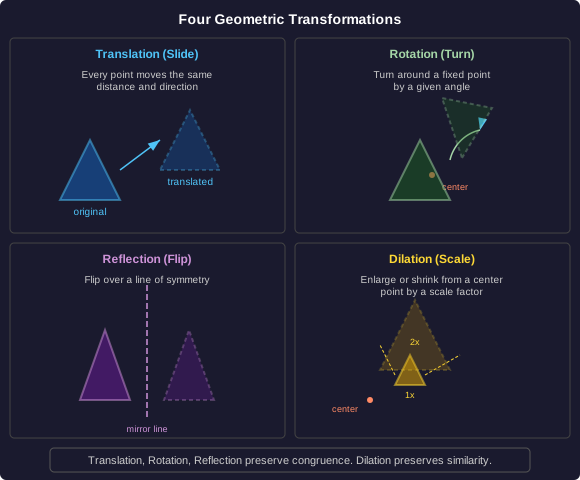
Translation (slide): Move every point the same distance in the same direction. The shape does not rotate or flip.
Rotation (turn): Turn the figure around a fixed point (the center of rotation) by a given angle.
Reflection (flip): Flip the figure over a line (the line of reflection), creating a mirror image.
Dilation (scale): Enlarge or shrink the figure from a center point by a scale factor.
The first three: translation, rotation, and reflection: are called rigid motions because they preserve both shape and size. The result is always congruent to the original.
Dilation changes size but preserves shape. The result is similar to the original.
Reflection Practice
Reflecting Over an Axis
When you reflect a point over the y-axis, the x-coordinate changes sign (positive becomes negative, or vice versa) while the y-coordinate stays the same.
What Is a Proof?
The Logic of Geometry
A geometric proof is a logical argument that shows why a statement must be true. It is not enough to say something looks true: you must show why it is true.
Every proof follows a chain:
Given (what you start with) → Statement (a claim) → Reason (why that claim is true) → ... → Conclusion
Each reason must be one of three things:
- A definition (e.g., 'a right angle is 90 degrees')
- A postulate (a basic truth we accept without proof, e.g., 'through any two points there is exactly one line')
- A theorem (something already proven, e.g., 'vertical angles are equal')
Proofs are the backbone of geometry. They are how mathematicians have built knowledge for over 2,000 years, starting with Euclid's Elements.
Parallel Lines and Angles
A Classic Geometry Fact
When two parallel lines are cut by a transversal (a line that crosses both), several angle relationships are created.
One of the most important: the alternate interior angles: the angles on opposite sides of the transversal, between the parallel lines.
SOH-CAH-TOA
The Ratios Inside Right Triangles
Trigonometry starts with a simple observation: in a right triangle, if you know one of the acute angles, the ratios of the sides are fixed: no matter how big or small the triangle is.
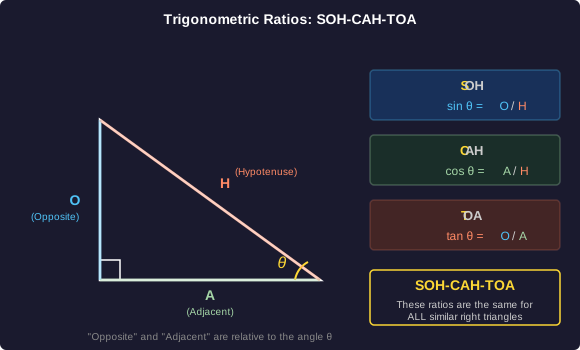
For any acute angle θ in a right triangle:
Sine (sin θ) = Opposite / Hypotenuse
Cosine (cos θ) = Adjacent / Hypotenuse
Tangent (tan θ) = Opposite / Adjacent
The mnemonic SOH-CAH-TOA helps you remember:
- Sine = Opposite / Hypotenuse
- Cosine = Adjacent / Hypotenuse
- Tangent = Opposite / Adjacent
These ratios are the same for ALL similar right triangles with the same angles. A tiny 30-60-90 triangle & a huge 30-60-90 triangle have the same sine, cosine, & tangent values.
Using Sine
Solve with Trigonometry
A right triangle has an angle of 30°. The side opposite the 30° angle is 5 cm.
You are given that sin 30° = 0.5.
Where Geometry Lives
Geometry Is Everywhere
The concepts you have learned: congruence, similarity, transformations, proofs, and trigonometry: are not just classroom ideas. They are tools used every day in the real world:
Architecture: Buildings use triangles for structural strength. A triangle is the only polygon that cannot be deformed without changing side lengths. That is why roof trusses, bridges, and cranes are full of triangles.
Navigation: Triangulation uses the angles from two known points to find the position of a third. This is how GPS satellites determine your location.
Computer Graphics: Every 3D model in a video game or movie is made of thousands of tiny triangles (polygon meshes). Transformations (translation, rotation, scaling) move those models around the screen.
Sports: The angle of a billiard ball's reflection off a cushion equals its angle of approach. Quarterbacks calculate throwing angles. Skateboarders use ramp angles.
Engineering: Mechanical parts must fit within tolerances measured in thousandths of an inch. Geometric proofs ensure that designs will work before anything is built.
Ladder Problem
Putting It All Together
A ladder leans against a wall. The ladder touches the wall 12 feet up. The base of the ladder is 5 feet from the wall.
The wall, the ground, & the ladder form a right triangle.