Welcome
Welcome to geometry!
The word geometry comes from two Greek words: geo (earth) & metria (measurement). Thousands of years ago, people invented geometry to measure land, build buildings, & understand the shapes they saw all around them.
Today you are going to learn the basic building blocks of geometry: points, lines, angles, shapes, and symmetry.
Let's get started!
Points, Lines, Rays, and Segments
The Building Blocks
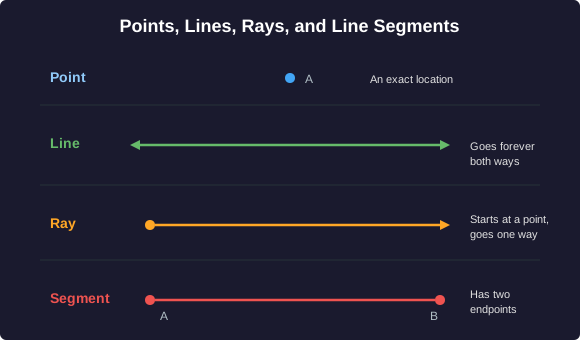
Here are the four building blocks of geometry:
- A point is an exact location. We draw it as a dot & label it with a letter like A.
- A line goes on forever in both directions. It has arrows on both ends to show it never stops.
- A ray starts at a point and goes on forever in one direction. Think of a flashlight beam: it starts somewhere and shines outward.
- A line segment has two endpoints. It is the part of a line between two points: like the edge of your desk.
Lines vs. Rays
Your Turn
Think about the difference between a line & a ray.
What is an Angle?
Angles
An angle is formed when two rays meet at a point. That meeting point is called the vertex.
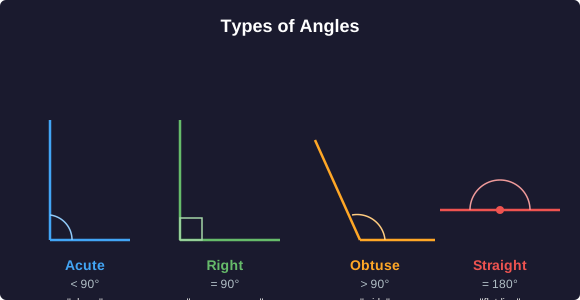
There are four main types of angles:
- Acute angle: less than 90 degrees. It looks sharp and pointy, like the tip of a pizza slice.
- Right angle: exactly 90 degrees. It makes a perfect square corner, like the corner of a book or a door frame.
- Obtuse angle: more than 90 degrees but less than 180. It looks wide and lazy, like leaning back in a chair.
- Straight angle: exactly 180 degrees. It looks like a flat line.
Here is a trick: if the angle fits inside a square corner, it is acute. If it is bigger than a square corner, it is obtuse.
Name That Angle
Your Turn
Imagine picking up a book & opening it partway, so the front & back covers make a V shape.
What is a Polygon?
Polygons
A polygon is a closed shape made of straight sides. The sides connect end to end with no gaps.

Here are the most common polygons:
- Triangle: 3 sides (tri = three)
- Quadrilateral: 4 sides (quad = four). Squares and rectangles are special quadrilaterals!
- Pentagon: 5 sides (penta = five)
- Hexagon: 6 sides (hexa = six). Honeycombs are made of hexagons!
- Octagon: 8 sides (octa = eight)
Notice the pattern? The name tells you how many sides the shape has.
Name That Shape
Your Turn
Think about a stop sign. It has 8 sides.
Lines of Symmetry
Symmetry
A shape has symmetry if you can fold it in half & both sides match exactly.
The fold line is called a line of symmetry.
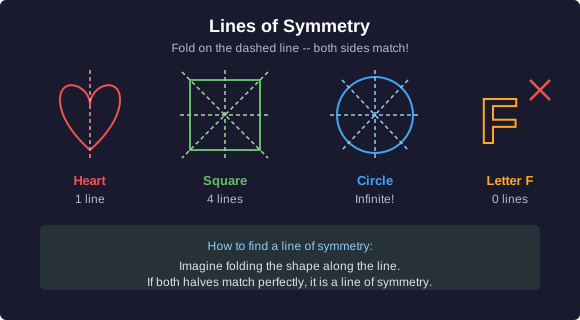
Some shapes have many lines of symmetry, & some have none:
- A heart has 1 line of symmetry: fold it down the middle vertically.
- A square has 4 lines of symmetry: vertical, horizontal, and both diagonals.
- A circle has infinite lines of symmetry: you can fold it through the center in any direction!
- The letter F has 0 lines of symmetry: no matter how you fold it, the two sides do not match.
Try this at home: cut a shape out of paper & fold it. If both halves match perfectly, the fold is a line of symmetry!
Finding Symmetry
Your Turn
Think about the capital letter A.
What is Perimeter?
Perimeter
The perimeter of a shape is the total distance around the outside.
Imagine walking around the edge of a soccer field. The distance you walk is the perimeter.
To find the perimeter, add up the lengths of all the sides.
Rectangle shortcut:
A rectangle has two long sides (length) & two short sides (width).
So the perimeter = length + length + width + width, which is the same as:
Perimeter = 2 x length + 2 x width
For example, a rectangle that is 6 meters long & 3 meters wide has a perimeter of:
2 x 6 + 2 x 3 = 12 + 6 = 18 meters
Calculate the Perimeter
Your Turn
A rectangular garden is 8 meters long & 5 meters wide.