What Is Area?
Area: The Space Inside a Shape
Area is the amount of space inside a flat (2D) shape. Think of it as the number of square tiles you would need to cover a surface completely.
We measure area in square units: cm², m², ft², in². The little ² means we are counting squares.
Here are the most important area formulas you will use:

- Rectangle: Area = length × width
- Triangle: Area = ½ × base × height
- Circle: Area = π × r²
- Parallelogram: Area = base × height
Notice that every area formula involves multiplying two lengths together. That is why the units are always squared: you are multiplying meters × meters to get square meters.
Rectangle Area
Putting the Formula to Work
A standard basketball court is 28 meters long & 15 meters wide. It is a rectangle.
To find its area, we multiply: Area = length × width.
Triangle Area
Why Is Triangle Area ½ × base × height?
Here is the key insight: every triangle is exactly half of a rectangle.
Draw any triangle. Now imagine copying it, flipping the copy, & fitting it against the original. You get a rectangle (or parallelogram) with the same base & height.
Since the triangle is half the rectangle:
- Rectangle area = base × height
- Triangle area = ½ × base × height
The base is any side you choose. The height is the perpendicular distance from the base to the opposite point: it must form a 90° angle with the base.
Example: a triangle with base 10 cm & height 6 cm has area = ½ × 10 × 6 = 30 cm².
Circle Area
Circles: π Makes an Appearance
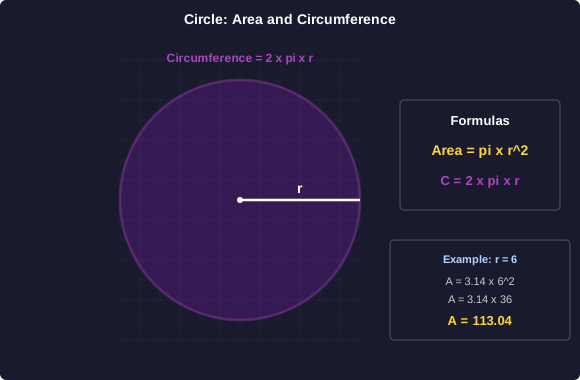
A circle's area depends on its radius (r): the distance from the center to the edge.
Area = π × r²
Where π (pi) ≈ 3.14. It is a special number that shows up whenever circles are involved.
To find circle area: square the radius first, then multiply by π.
The circumference (distance around the circle) is:
C = 2 × π × r
Notice the difference: area uses r² (gives square units), circumference uses just r (gives linear units).
Pizza Math
Time for Pizza Math
A circular pizza has a radius of 6 inches.
Breaking Down Complex Shapes
Composite Shapes: Divide & Conquer
Real-world shapes are rarely perfect rectangles or circles. A room might be L-shaped. A yard might combine a rectangle & a triangle. A window might be a rectangle topped with a semicircle.
The strategy is always the same:
1. Break the complex shape into simple shapes you know (rectangles, triangles, circles)
2. Calculate the area of each simple shape
3. Add them together for the total area
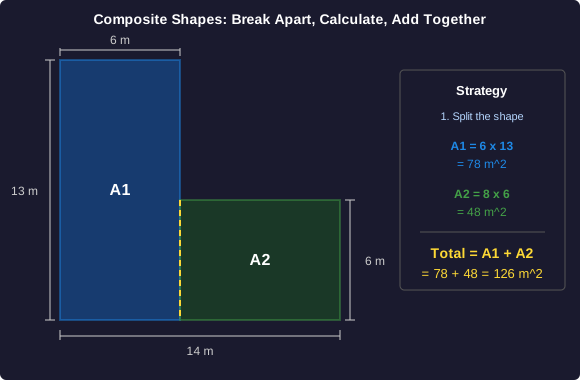
Sometimes you need to subtract instead of add: like finding the area of a wall with a window cut out. Wall area minus window area equals the area you need to paint.
L-Shaped Room
The L-Shaped Room
An L-shaped room comes from two rectangles joined together.
- Rectangle 1 is 10 m × 4 m
- Rectangle 2 is 6 m × 3 m
What Is Volume?
Volume: The Space Inside a 3D Shape
Just as area measures the space inside a flat shape, volume measures the space inside a three-dimensional solid.
Think of volume as the number of tiny cubes you could pack inside the shape.
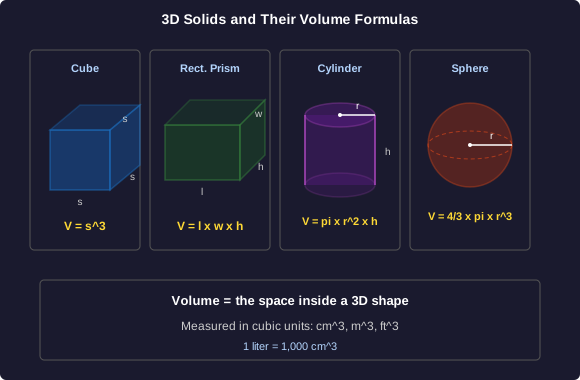
The key formulas:
- Cube: V = s³ (side × side × side)
- Rectangular prism (box): V = l × w × h (length × width × height)
- Cylinder: V = π × r² × h (the area of the circular base × height)
- Sphere: V = 4/3 × π × r³
Volume is measured in cubic units: cm³, m³, ft³. The little ³ means we are counting cubes.
A useful conversion: 1 liter = 1,000 cm³. That is how we connect geometry to real-world measurements like how much water a container holds.
Fish Tank Volume
How Much Water Does the Tank Hold?
A rectangular fish tank is 60 cm long, 30 cm wide, & 40 cm tall.
First find the volume in cm³, then convert to liters.
Remember: 1 liter = 1,000 cm³.
Navigating the Grid
The Coordinate Plane
The coordinate plane is a grid for plotting points using two numbers.
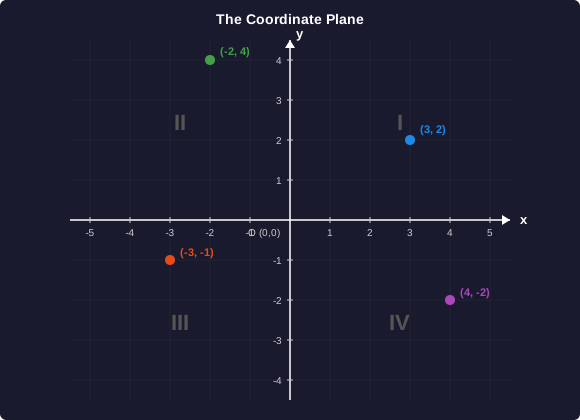
The key parts:
- X-axis: the horizontal number line (left–right)
- Y-axis: the vertical number line (up–down)
- Origin: the point (0, 0) where the axes cross
- Coordinates: every point is written as (x, y): horizontal first, vertical second
The Four Quadrants
The axes divide the plane into four regions called quadrants:
- Quadrant I (top right): x is positive, y is positive: like (3, 2)
- Quadrant II (top left): x is negative, y is positive: like (-2, 4)
- Quadrant III (bottom left): x is negative, y is negative: like (-3, -1)
- Quadrant IV (bottom right): x is positive, y is negative: like (4, -2)
Think of it like a map: x tells you how far east or west, y tells you how far north or south.
Shape from Points
Connecting the Dots
When you plot points on the coordinate plane & connect them in order, you can create shapes.
Try this: plot the points (0, 0): (4, 0): (4, 3): & (0, 3) & connect them.