Welcome
Today we will explore one of the most useful ideas in all of mathematics: fractions.
Fractions show up everywhere: slicing pizza, measuring ingredients, splitting a bill, tuning a guitar, even building a house.
By the end of this lesson, you will understand what fractions are, how to find equivalent fractions, & how to add fractions with different denominators.
And here is the best part: you already use fractions every day. You just might not realize it yet.
Warm-Up
A Quick Thought
Imagine you and a friend are sharing something: a candy bar, a bag of chips, a pizza.
You split it, but one piece is clearly bigger than the other.
Two Parts
Numerator & Denominator
A fraction has two parts:
- The denominator (bottom number) tells you how many equal pieces something is divided into
- The numerator (top number) tells you how many of those pieces you have
Think of a pizza cut into 8 equal slices.
If you eat 3 slices, you ate 3/8 of the pizza.
The 8 tells you how many slices total. The 3 tells you how many you took.
If someone eats the whole pizza, that is 8/8: which equals 1 whole pizza.
If nobody eats any, that is 0/8: which equals 0.
Pizza Slices
Your Turn
Picture a pizza cut into 8 equal slices.
You eat 3 slices.
Same Amount, Different Look
Equivalent Fractions
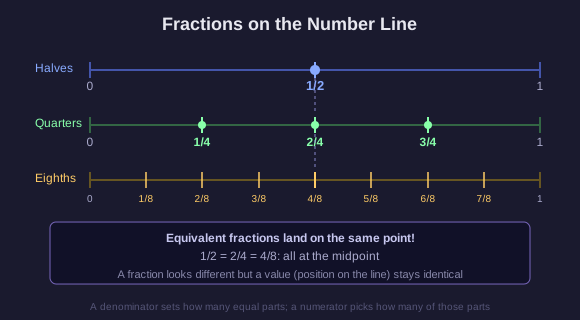
Here is something that surprises a lot of people: different fractions can represent the exact same amount.
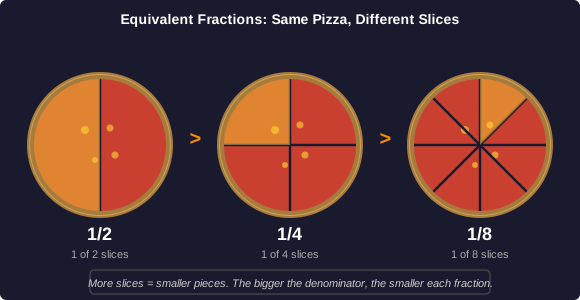
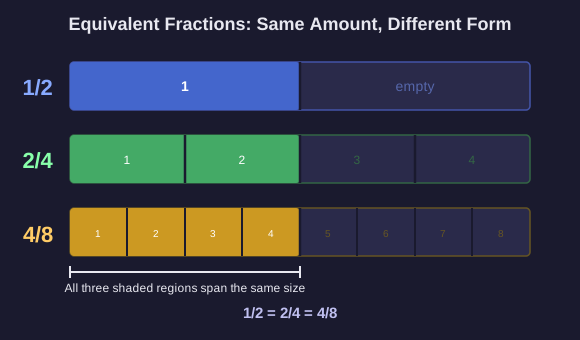
Imagine cutting a pizza in half: you get 1/2 of the pizza.
Now imagine cutting that same pizza into 4 slices and taking 2: you get 2/4 of the pizza.
And if you cut it into 8 slices and take 4: that is 4/8 of the pizza.
1/2 = 2/4 = 4/8
They look different, but they are the same amount of pizza. These are called equivalent fractions.
The trick: if you multiply (or divide) the numerator AND the denominator by the same number, the value does not change.
- 1/2 × 2/2 = 2/4
- 1/2 × 4/4 = 4/8
- 6/9 ÷ 3/3 = 2/3
Are They Equal?
Your Turn
Look at these two fractions: 2/3 & 4/6.
Same Denominator: Easy
Adding Fractions with the Same Denominator
When two fractions have the same denominator, adding them is simple: just add the numerators.
1/5 + 2/5 = 3/5
Why? Because both fractions are counting the same-size pieces (fifths). One fifth plus two fifths equals three fifths: just like 1 apple plus 2 apples equals 3 apples.
The denominator stays the same. You do NOT add the denominators.
- 1/5 + 2/5 = 3/5 (correct)
- 1/5 + 2/5 = 3/10 (WRONG: a common mistake)
Different Denominators: The Key Step
Adding Fractions with Different Denominators
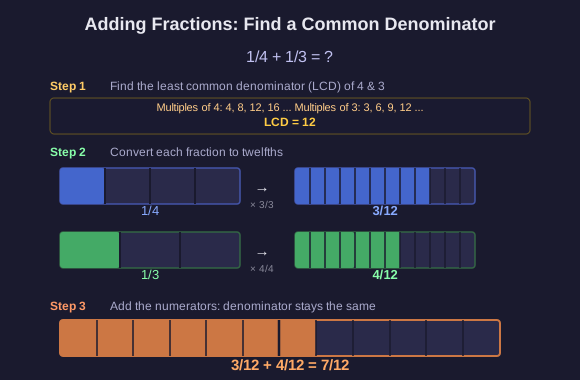
What about 1/4 + 1/3?
You cannot just add the numerators because the pieces are different sizes: fourths and thirds are not the same thing.
You need a common denominator: a number that both 4 and 3 divide into evenly.
The smallest common denominator for 4 & 3 is 12.
Convert both fractions:
- 1/4 = 3/12 (multiply top & bottom by 3)
- 1/3 = 4/12 (multiply top & bottom by 4)
Now add: 3/12 + 4/12 = 7/12
The key idea: make the pieces the same size first, then add.
Fractions Everywhere
Fractions in the Wild
Fractions are not just a school topic: they show up constantly in real life.
Cooking: A recipe calls for 3/4 cup of flour. You want to double it: that is 3/4 + 3/4 = 6/4 = 1 1/2 cups.
Building: A board is 5/8 of an inch thick. You stack two: that is 10/8 = 1 1/4 inches.
Music: Most popular songs are in 4/4 time: four beats per measure. A waltz is in 3/4 time: three beats per measure. The fraction tells musicians how to count.
Sports: A basketball player makes 7 out of 10 free throws. Their free throw fraction is 7/10, or 70%.
Put It All Together
Challenge Problem
You are ready for this. Use everything you have learned: equivalent fractions, common denominators, and adding fractions.
Here is the problem:
You & two friends are painting a fence. You paint 1/4 of the fence. Your first friend paints 1/3 of the fence. Your second friend paints 1/6 of the fence. What fraction of the fence did the three of you paint together? Is the fence finished?
Take your time. Show each step.
What You Learned
Well Done
Today you covered a lot of ground:
- Numerator and denominator: what the top and bottom numbers mean
- Equivalent fractions: same value, different form
- Adding fractions: find a common denominator first, then add the numerators
- Real-world applications: cooking, building, music, and more
These same fraction skills are the foundation of algebra, physics, chemistry, & engineering. Every time you see a fraction from now on, you will know exactly what it means.