Welcome
Every living thing on Earth: every bacterium, every oak tree, every blue whale, and every human: runs on the same molecular instruction manual.
That instruction manual is DNA, short for deoxyribonucleic acid.
DNA is in nearly every cell of your body. It tells your cells how to build proteins, which do almost all the work of keeping you alive. It decided your eye color before you were born. It is why a cat is a cat & not a cactus.
In this lesson, we will take DNA apart piece by piece. By the end, you will understand how a molecule made of just four chemical letters can encode the instructions for all of life.
Warm-Up
Before we dive in, let's start with a question.
Double Helix
The Shape of DNA
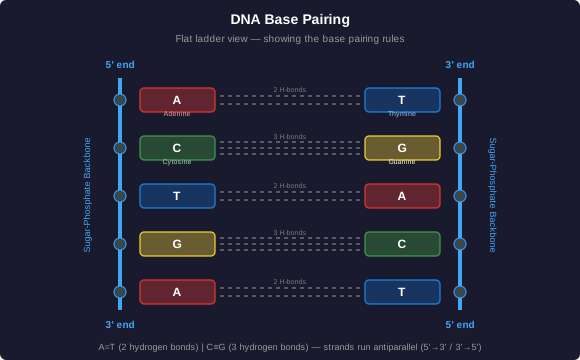
DNA looks like a twisted ladder: a shape scientists call a double helix.
The two long sides of the ladder are called the sugar-phosphate backbone. They come from alternating sugar molecules (deoxyribose) & phosphate groups, & they hold the whole structure together.
The rungs of the ladder are the important part. Each rung comes from two bases that pair together. There are four bases:
- A (adenine)
- T (thymine)
- C (cytosine)
- G (guanine)
Here is the critical rule: A always pairs with T, & C always pairs with G. Always. In every species. These are called base pairs, & a single base plus its sugar & phosphate is called a nucleotide.
A stretch of human DNA might read: ATCGGCTAA. If you know one side, you automatically know the other: because A pairs with T, and C pairs with G.
Who Discovered It?
The Race to Discover DNA's Structure
In 1953, James Watson & Francis Crick published the structure of DNA. They won the Nobel Prize for it in 1962.
But they could not have done it without Rosalind Franklin.
Franklin was a brilliant chemist at King's College London. She used X-ray crystallography: firing X-rays at DNA crystals and reading the patterns they made: to produce Photo 51, the clearest image of DNA's structure anyone had ever seen.
Her colleague Maurice Wilkins showed Photo 51 to Watson without Franklin's knowledge or permission. Watson later wrote that the moment he saw it, the double helix structure became obvious.
Franklin never received the Nobel Prize. She died of ovarian cancer in 1958 at age 37: possibly caused by her extensive X-ray work: and Nobel Prizes are not awarded posthumously. Watson and Crick barely acknowledged her contribution at the time.
Today, scientists recognize that Franklin's experimental work was essential. She was robbed of credit during her lifetime, and her story is a reminder that science is done by people: and people are not always fair.
How DNA Copies Itself
Copying the Code
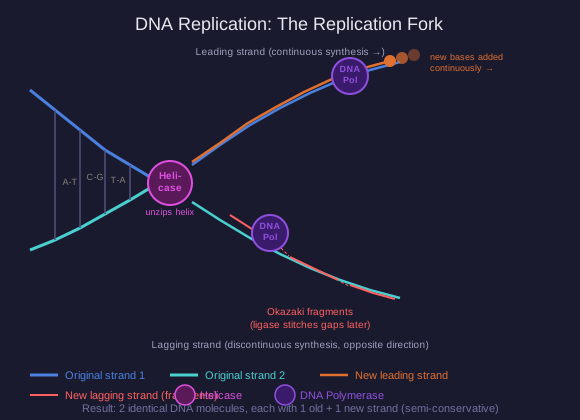
Every time a cell divides: to heal a wound, to grow, or to replace worn-out cells: it must first make an exact copy of all its DNA. This process is called replication.
Here is how it works:
1. An enzyme called helicase unzips the double helix by breaking the hydrogen bonds between base pairs. It literally splits the ladder down the middle.
2. Another enzyme called DNA polymerase reads each exposed strand & builds a new matching strand, following the base pairing rules (A with T, C with G).
3. The result: two identical copies of the original DNA molecule. Each copy has one old strand & one new strand.
Your body does this roughly 3.8 million times per second. And it gets it right almost every time: DNA polymerase makes about one mistake per billion bases copied. When it does make a mistake, other enzymes usually catch and fix the error.
But not always. When a mistake slips through, it becomes a mutation. We will talk about why that matters soon.
Transcription and Translation
How DNA Builds Things
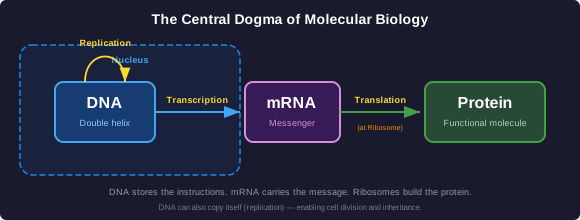
DNA does not build your body directly. It works through an intermediary called RNA (ribonucleic acid).
The process has two major steps:
Step 1: Transcription (DNA → mRNA)
A section of DNA (a gene) gets copied into a molecule called messenger RNA (mRNA). Think of it as making a photocopy of one page from a massive instruction manual. The original stays safe in the nucleus; the copy goes out to the factory floor.
Step 2: Translation (mRNA → Protein)
Ribosomes: the cell's protein-building machines: read the mRNA three letters at a time. Each group of three letters is called a codon. Each codon specifies one amino acid. String the amino acids together and you get a protein.
For example, the codon AUG codes for the amino acid methionine & also signals 'start building here.' The codon UAA signals 'stop.'
A single gene might code for a protein with hundreds of amino acids. That protein might become an enzyme that digests your food, a hemoglobin molecule that carries oxygen in your blood, or a keratin fiber that makes up your hair.
One gene → one mRNA → one protein → one job in your body. (This is simplified: reality is messier: but it captures the core logic.)
When Genes Mutate
What Happens When the Code Changes?
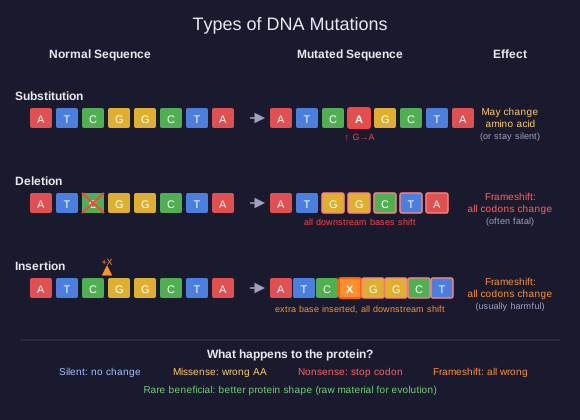
A mutation is any change in the DNA sequence. It could be a single base swapped for another, a base deleted, or extra bases inserted.
Some mutations do nothing: the codon still codes for the same amino acid (there is redundancy built into the genetic code). These are called silent mutations.
Some mutations change one amino acid but the protein still works. Some change a critical amino acid & the protein breaks.
And some mutations: very rarely: produce a protein that works better than the original.
Why We All Differ
Where Variation Comes From
If DNA copies itself so accurately, why are we not all identical?
Three main sources of genetic variation:
1. Mutations: Random copying errors, UV radiation, or chemical exposure can change bases in DNA. Most mutations are neutral. Some are harmful. A few are beneficial.
2. Sexual reproduction: When organisms reproduce sexually, each parent contributes half their DNA. The specific combination is random. You share 50% of your DNA with each parent, but which 50% you got was a genetic lottery. This is why siblings look similar but not identical.
3. Recombination: During the formation of egg and sperm cells, chromosomes physically swap segments with each other. This shuffles gene combinations in ways that neither parent had.
Why Variation Matters
Genetic variation is not a flaw: it is a survival strategy. A population where every individual is genetically identical is vulnerable. One disease could wipe out the entire group because no one has resistance.
But in a genetically diverse population, some individuals will have mutations that happen to make them resistant. They survive, reproduce, and pass on that resistance. This is natural selection: the engine of evolution.
Every adaptation you can think of: the cheetah's speed, the cactus's water storage, the human brain: started as a random mutation that happened to be useful.
CRISPR and Gene Editing
Rewriting the Code of Life
For billions of years, changes to DNA happened slowly: through random mutation and natural selection.
That changed in 2012.
Jennifer Doudna & Emmanuelle Charpentier discovered that a bacterial defense system called CRISPR-Cas9 could be reprogrammed to cut DNA at any precise location. They won the Nobel Prize in Chemistry in 2020.
CRISPR works like molecular scissors with a GPS. You give it a guide RNA that matches the DNA sequence you want to edit, and the Cas9 protein cuts the DNA at that exact spot. Then the cell's own repair machinery fixes the cut: and you can slip in a corrected gene while it does.
This is revolutionary. Scientists have already used CRISPR to:
- Cure sickle cell disease in clinical trials by editing patients' blood stem cells
- Create disease-resistant crops without traditional breeding
- Develop potential treatments for muscular dystrophy, certain cancers, & HIV
But CRISPR also raises enormous ethical questions.
In 2018, a Chinese scientist named He Jiankui announced he had used CRISPR to edit the DNA of human embryos: twin girls born with modified genes. The global scientific community condemned this as reckless and premature. He was sentenced to three years in prison.
The core dilemma: editing the DNA of an embryo changes every cell in the resulting person, & those changes get passed to their children, & their children's children. We are talking about permanently altering the human gene pool.
Genetic testing raises its own questions. Today you can spit in a tube & learn your risk for hundreds of diseases. But should employers or insurance companies have access to that information? Should parents be able to select embryos based on traits like intelligence or athleticism?
Should We Edit Human DNA?
Your Turn to Argue
There is no single right answer to these questions. But there are well-reasoned answers & poorly-reasoned answers.
A strong argument considers both the potential benefits & the risks, uses evidence, & acknowledges the complexity of the issue.
What Will You Remember?
One Last Thought
You started this lesson with a question about cats.
Now you know the answer lives in a twisted ladder of four chemical letters: a code so elegant that it runs every living thing on the planet, and so powerful that we are only just learning how to rewrite it.
The science of DNA is moving faster than at any point in human history. The students learning this material right now will be the ones making decisions about how it is used.