Welcome
Close your eyes for a second. Now open them.
Everything you just saw: the walls, the sky, your hands, the screen: has color. You are surrounded by it every waking moment.
But most people never really see color. They see a red apple, a blue sky, a green tree, & move on.
Artists see differently. They notice that the shadow under that red apple is not black: it is a deep violet. They see that the sky is not one blue but twenty. They see that a leaf in sunlight is a completely different green than a leaf in shade.
Today, you will learn to see like an artist.
Your Favorite Color
Let's start with something personal.
Building Blocks of Color
The Three Primaries
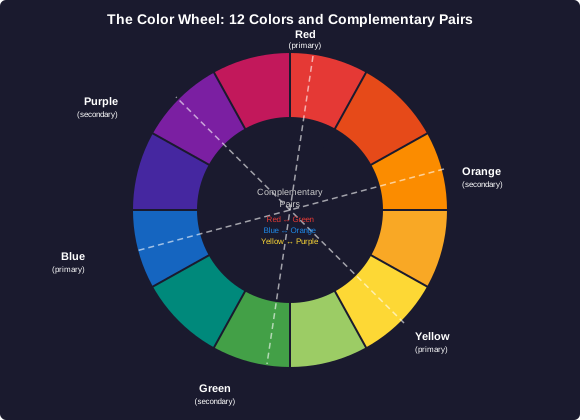
Every color you have ever seen can be built from just three: red, blue, & yellow.
These are called primary colors because they cannot be made by mixing other colors together. They are the starting points.
When you mix two primaries together, you get a secondary color:
- Red + Yellow = Orange
- Yellow + Blue = Green
- Blue + Red = Purple (or violet)
And when you mix a primary with a neighboring secondary, you get a tertiary color: like red-orange, yellow-green, or blue-violet. That gives us twelve colors arranged in a circle: the color wheel.
The color wheel is not just a chart. It is a map. And like any good map, it tells you how things relate to each other.
Color Temperature
Colors Have Temperature
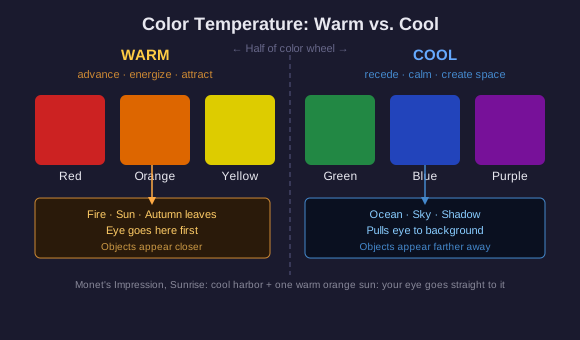
Look at the color wheel & draw an imaginary line down the middle. On one side, you get the warm colors: red, orange, & yellow. On the other, the cool colors: blue, green, & purple.
This is not just a label: warm and cool colors actually change how a painting feels.
Warm colors advance. They jump forward, grab your attention, & create energy. Think of fire, sunlight, autumn leaves.
Cool colors recede. They pull back, calm you down, & create space. Think of ocean water, forest shade, a winter sky.
Claude Monet, the Impressionist painter, was obsessed with this. Look at his painting Impression, Sunrise (1872): the entire harbor is painted in cool blues and grays, but the sun and its reflection are a vivid warm orange. That tiny spot of warmth is what your eye goes to first.
Artists use this trick constantly: warm colors pull things forward, cool colors push things back.
Opposites Attract
Colors That Vibrate
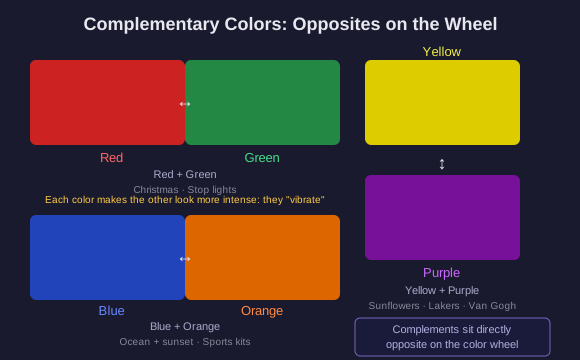
On the color wheel, every color has an opposite: the color directly across from it. These pairs are called complementary colors:
- Red & Green
- Blue & Orange
- Yellow & Purple
When you put complementary colors next to each other, something electric happens. They seem to vibrate. Each color makes the other look brighter, more intense, almost buzzing.
Vincent van Gogh understood this better than anyone. Look at The Starry Night (1889). The sky is a swirl of deep blues and blue-violets: and the stars and moon blaze with bright yellows and golds. Blue and yellow are near-complementary colors. That contrast is what makes the painting feel alive, almost pulsing with energy.
Van Gogh once wrote in a letter: Instead of trying to reproduce exactly what I have before my eyes, I use color more arbitrarily, in order to express myself forcibly.
Complementary colors are everywhere outside of art, too: in logos, uniforms, advertisements, and nature itself.
Power of Light & Dark
Value: The Secret Weapon
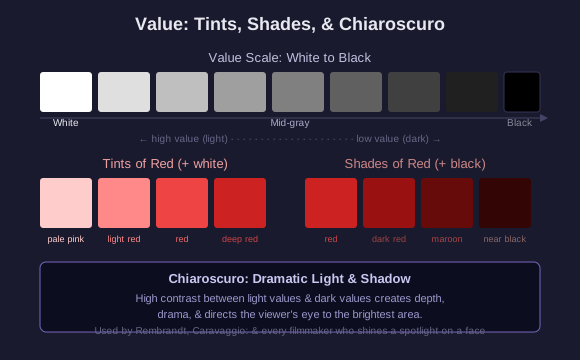
Color is not just about hue: whether something is red or blue. It is also about value: how light or dark that color is.
Add white to any color and you get a tint: a lighter version. Pink is a tint of red. Sky blue is a tint of blue.
Add black and you get a shade: a darker version. Maroon is a shade of red. Navy is a shade of blue.
Value is what creates the illusion of depth & three-dimensionality on a flat surface.
Rembrandt van Rijn, the Dutch master, was the king of value. His paintings use a technique called chiaroscuro: dramatic contrast between light and dark. In The Night Watch (1642), some figures blaze with light while others dissolve into shadow. The painting feels like a stage with a spotlight.
Rembrandt could paint an entire scene using mostly browns and golds, and it would still feel rich and deep: because the values were perfect. Light and shadow do the heavy lifting.
Seeing Your World
Your Turn: See Like an Artist
You now have a vocabulary for color that most people never learn: primary, secondary, tertiary, warm, cool, complementary, value, tint, shade, chiaroscuro.
That vocabulary changes what you can see. Before you knew the word complementary, you might have looked at Van Gogh's sky & just thought 'pretty.' Now you can say why it is powerful.
Art is not magic. It is choices: color choices, value choices, temperature choices: made by someone who learned to see.
What Will You See Differently?
One Last Thought
Before this lesson, a sunset was just pretty. Now you can see the warm oranges pushing forward & the cool purples pulling back. You can see complementary colors vibrating against each other. You can see value doing the quiet work of creating depth.
The world has not changed. Your eyes have.