Welcome
Earth's climate has always changed. Ice ages have come & gone. Warm periods have allowed forests to grow in Antarctica.
But what is happening now is different: not because the climate is changing, but because of how fast it is changing.
Over the past 150 years, the global average temperature has risen about 1.1°C. That might sound small, but the difference between now and the last ice age: when glaciers covered most of North America: was only about 5°C.
In this lesson, we will look at the evidence, understand the mechanisms, & think critically about what we can do.
What Do You Know?
Before we dig in, let's find out where you start from.
How Earth Stays Warm
The Greenhouse Effect
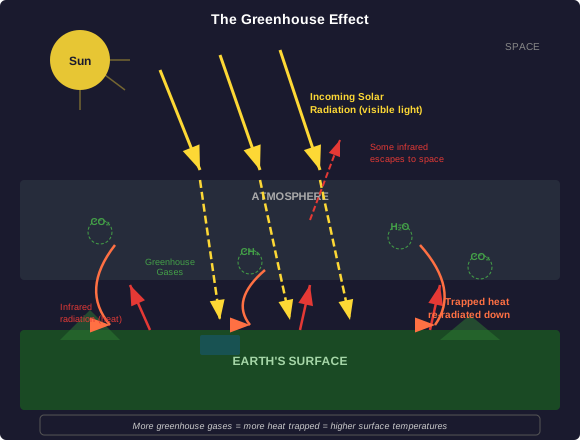
The greenhouse effect is not a bad thing. Without it, Earth's average temperature would be about -18°C (0°F): far too cold for liquid water or life as we know it.
Here is how it works:
1. The Sun sends energy to Earth as visible light.
2. Earth's surface absorbs that light & re-emits it as infrared radiation (heat).
3. Certain gases in the atmosphere: carbon dioxide (CO₂), methane (CH₄), water vapor (H₂O), and nitrous oxide (N₂O): absorb that infrared radiation instead of letting it escape to space.
4. These gases re-emit the heat in all directions, including back toward Earth's surface.
This is what keeps our planet at a livable average of about 15°C (59°F).
The concern is not the greenhouse effect itself: it is that we are strengthening it by adding more of these gases to the atmosphere.
What the Evidence Shows
The Evidence for Climate Change
Climate science is built on multiple independent lines of evidence. Here are the major ones:
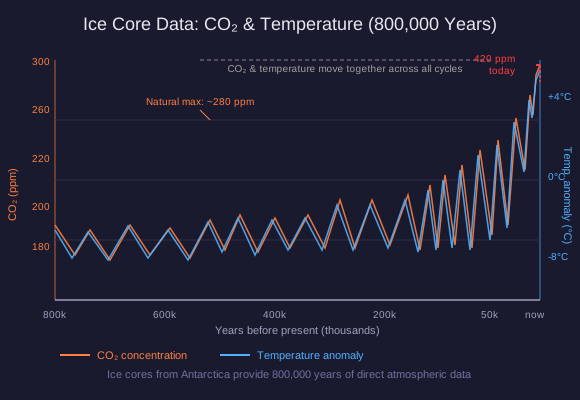
Ice cores: Scientists drill deep into ice sheets in Antarctica and Greenland, extracting cylinders of ice that contain tiny bubbles of ancient atmosphere. These bubbles let us measure CO₂ and temperature going back 800,000 years. The data shows that CO₂ and temperature have always moved together: and that current CO₂ levels are far higher than anything in that 800,000-year record.
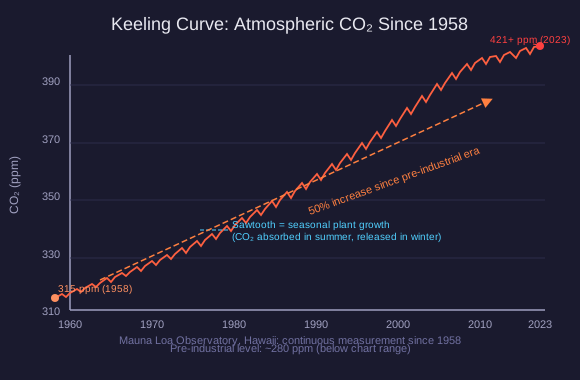
The Keeling Curve: In 1958, Charles David Keeling began measuring atmospheric CO₂ at Mauna Loa Observatory in Hawaii. His measurements show a relentless upward trend from 315 ppm to over 420 ppm today, with a distinctive sawtooth pattern caused by seasonal plant growth.
Temperature records: Thermometer records going back to the 1850s show a clear warming trend, especially since 1980. The ten warmest years on record have all occurred since 2010.
Sea level rise: Global sea level has risen about 20 cm (8 inches) since 1900, and the rate is accelerating. This comes from two sources: thermal expansion (warm water takes up more space) and melting ice.
Glacier retreat: Glaciers worldwide are shrinking. Glacier National Park in Montana had 150 glaciers in 1850; today fewer than 25 remain.
Ocean acidification: The ocean absorbs about 30% of the CO₂ we emit. This forms carbonic acid, making the water more acidic: a 26% increase in acidity since pre-industrial times. This threatens coral reefs and shellfish.
Carbon We Released
How Humans Changed the Atmosphere
For millions of years, carbon was locked underground in the form of coal, oil, and natural gas: the remains of ancient plants and marine organisms buried and compressed over geological time.
Starting with the Industrial Revolution around 1760, we began digging up those fossil fuels & burning them for energy. Burning carbon-based fuel combines the carbon with oxygen, releasing CO₂ into the atmosphere.
The numbers:
- Pre-industrial CO₂: approximately 280 ppm
- Current CO₂: over 420 ppm: a 50% increase
- Humans emit roughly 36 billion tonnes of CO₂ per year
Other major sources of greenhouse gases:
- Deforestation: Trees absorb CO₂. Cutting them down removes a carbon sink AND releases stored carbon.
- Agriculture: Rice paddies and livestock produce methane. Fertilizers release nitrous oxide. Agriculture accounts for about 10% of global emissions.
- Cement production: Making cement releases CO₂ from limestone. It accounts for about 8% of global emissions.
The natural carbon cycle moves carbon between the atmosphere, oceans, soil, & living things. But we have disrupted this cycle by adding carbon that was safely stored underground for millions of years.
What Happens Next
Consequences of a Warming World
Climate change is not just about higher temperatures. It triggers a cascade of interconnected effects:
Sea level rise: Thermal expansion of water plus melting ice sheets could raise sea levels 0.3 to 1 meter by 2100. Hundreds of millions of people live in coastal areas that would be affected.
Extreme weather: Warmer air holds more moisture, leading to more intense rainfall and flooding. Higher ocean temperatures fuel stronger hurricanes. Droughts intensify in already-dry regions.
Ecosystem disruption: Species must migrate, adapt, or face extinction. Coral reefs bleach and die in warmer, more acidic water. Growing seasons shift, affecting agriculture.
Feedback Loops
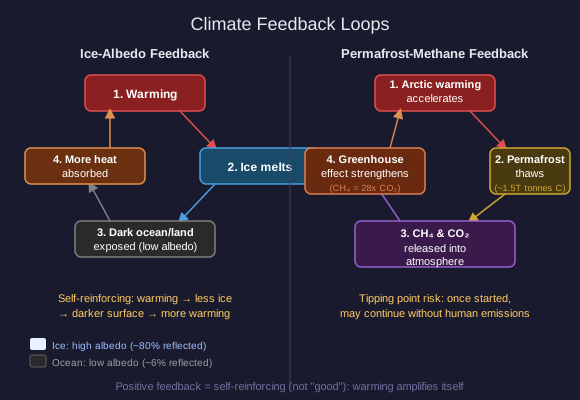
Some consequences of warming actually cause more warming: these are called positive feedback loops (positive here means self-reinforcing, not good):
- Melting permafrost: Arctic permafrost contains vast amounts of methane and CO₂ from ancient organic matter. As the Arctic warms, this permafrost thaws and releases those gases, which cause more warming, which melts more permafrost.
- Ice-albedo feedback: White ice reflects sunlight. When ice melts, it exposes dark ocean or land, which absorbs more heat, which melts more ice.
- Water vapor feedback: Warmer air holds more water vapor, which is itself a greenhouse gas, trapping more heat.
What We Can Do
Approaches to Addressing Climate Change
There is strong scientific consensus that climate change is real, human-caused, & serious. But there is genuine, legitimate debate about the best ways to respond. Here are the main categories:
Mitigation: reducing emissions:
- Renewable energy (solar, wind, hydroelectric, geothermal)
- Nuclear power (zero carbon, but raises concerns about waste & safety)
- Electrifying transportation
- Energy efficiency improvements
- Reducing deforestation
Adaptation: preparing for changes already underway:
- Building sea walls & flood defenses
- Developing drought-resistant crops
- Relocating vulnerable communities
- Improving early warning systems for extreme weather
Carbon removal: taking CO₂ back out of the atmosphere:
- Reforestation & soil carbon sequestration
- Direct air capture technology (currently expensive & energy-intensive)
- Enhanced mineral weathering
Policy approaches:
- Carbon taxes or cap-&-trade systems
- International agreements (Paris Agreement)
- Regulations on emissions
- Subsidies for clean energy
The individual vs. systemic debate:
Some argue that personal choices (driving less, eating less meat, reducing waste) matter most. Others argue that systemic change: policy, infrastructure, technology: is the only thing that can work at scale. Most experts say both are needed.
What Will You Remember?
Wrapping Up
Today we covered a lot of ground:
- The greenhouse effect & why it matters
- Multiple lines of evidence showing climate change is real & accelerating
- How human activity disrupted the carbon cycle
- Consequences & feedback loops that amplify warming
- The range of solutions being proposed & debated
Climate science is built on physics, chemistry, geology, biology, & data from every continent & ocean. Understanding it requires exactly the kind of evidence-based thinking that makes good science.