Welcome
Today we will explore one of the biggest ideas in all of biology.
Every living thing on Earth: every tree, every mushroom, every whale, every bacterium, and every person: is made of cells.
Cells are the smallest units of life. Some organisms are just one cell. You come from roughly 37 trillion of them.
By the end of this lesson, you will understand what cells come from, how they work, & why scientists call them the building blocks of life.
What Do You Already Know?
Before we dive in, let's find out what you already know.
Inside a Cell
What Is Inside a Cell?
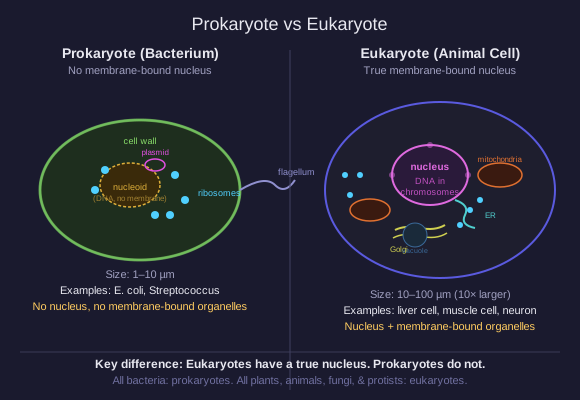
Think of a cell like a tiny factory. It has walls, a control center, machines, & fuel. Each part has a job.
Cell membrane: the outer boundary of the cell. It controls what enters and leaves, like a security gate.
Cytoplasm: the jelly-like fluid that fills the cell. All the other parts float inside it.
Nucleus: the control center. It holds the cell's DNA: the instructions for everything the cell does.
Organelles: specialized structures inside the cell that perform specific tasks. The word means 'little organs.'
Every cell has these basic parts, whether it belongs to a sunflower or a shark.
Nucleus & Beyond
The Nucleus: Mission Control
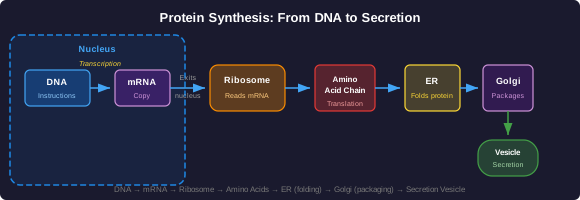
The nucleus is the largest organelle in most cells. It contains chromosomes, which are long strands of DNA: the molecule that stores genetic instructions.
Every time your body builds a new protein, repairs damage, or grows, the instructions come from DNA inside the nucleus.
Other important organelles include:
- Ribosomes: tiny machines that build proteins by reading instructions from DNA
- Endoplasmic reticulum (ER): a network of tunnels that transports materials through the cell
- Golgi apparatus: packages and ships proteins to where they are needed, like a post office
Two Kinds of Cells
Plant Cells vs Animal Cells
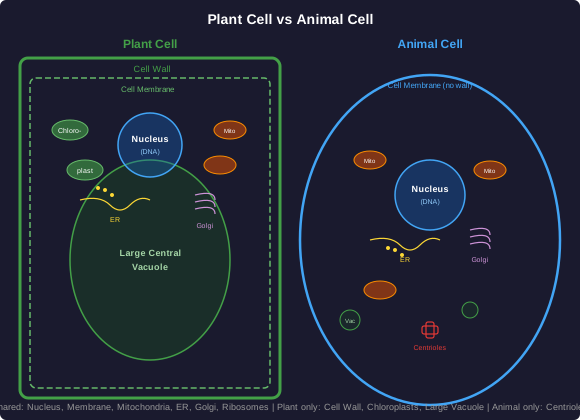
Both plant & animal cells have a membrane, nucleus, cytoplasm, & organelles. But plant cells have three extra features:
Cell wall: a rigid layer outside the membrane, made of cellulose. It gives plants their structure. This is why a tree trunk is stiff but your arm is flexible.
Chloroplasts: organelles that capture sunlight and convert it into food through photosynthesis. They contain a green pigment called chlorophyll: this is why leaves are green.
Large central vacuole: a big storage compartment filled with water and nutrients. It helps the plant stay rigid. When a plant wilts, it is because the vacuoles have lost water.
Animal cells do not have cell walls, chloroplasts, or a large central vacuole. Instead, animals get their energy by eating food: they do not make it from sunlight.
Mitochondria and Energy
The Powerhouse of the Cell
You have probably heard this phrase before. But what does it actually mean?
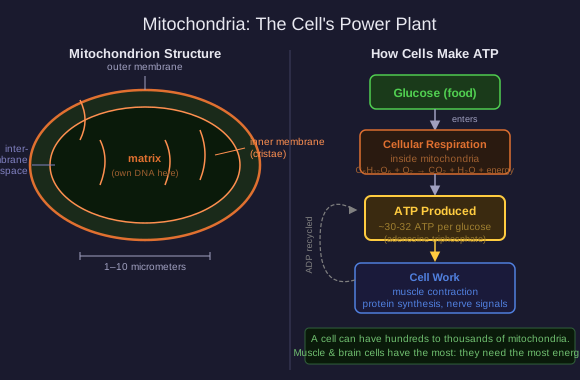
Mitochondria are organelles that convert food into usable energy. The energy molecule they produce is called ATP (adenosine triphosphate).
Think of ATP as a tiny rechargeable battery. Every time your muscles contract, your neurons fire, or your cells divide, they spend ATP to do it.
Here is what makes mitochondria truly fascinating:
- A single cell can contain hundreds or even thousands of mitochondria
- Cells that need more energy (like muscle cells & brain cells) have more mitochondria
- Mitochondria have their own DNA, separate from the DNA in the nucleus
- Scientists believe mitochondria were once free-living bacteria that got swallowed by a larger cell billions of years ago: and instead of being digested, they became partners. This is called endosymbiosis.
That last point means that deep inside your cells, there are structures that were once independent organisms. You are, in a sense, a collaboration.
How We See Cells
How Do We Know All This?
Cells are far too small to see with the naked eye. A typical human cell is about 10 micrometers across: that is 0.01 millimeters. You could fit about 100 cells across the width of a single millimeter.
We see cells using microscopes:
- Light microscopes can magnify up to about 1,000x: enough to see cells and some larger organelles
- Electron microscopes can magnify up to 2,000,000x: enough to see individual ribosomes and even the double layer of the cell membrane
The first person to see cells was Robert Hooke in 1665. He looked at a thin slice of cork through a microscope & saw tiny rectangular compartments. He called them cells because they reminded him of the small rooms (cells) where monks lived in a monastery.
What Hooke actually saw were the cell walls of dead plant cells: the living material inside had long since dried up. But the name stuck.
What Surprised You?
Looking Back
You have covered a lot of ground today: from the cell membrane to mitochondria, from plant cells to microscopes.
Cells are everywhere. Right now, trillions of them are working together to keep you alive, & each one is running its own miniature factory.
Your Takeaway
One Last Thought
Every living thing on this planet shares the same basic building block: the cell.
A bacteria cell, a leaf cell, & a human brain cell all use DNA, all have membranes, & all run on ATP.
That shared design is one of the strongest pieces of evidence that all life on Earth is connected: descended from a common ancestor billions of years ago.