Welcome
Everything you can see, touch, smell, or taste comes from atoms.
Your body. The air. The screen you are reading this on. The farthest star.
Atoms are so small that a single drop of water contains more atoms than there are stars in the observable universe.
In this lesson, we are going to zoom in: way in: and find out what atoms are, how they behave, and why understanding them unlocks all of chemistry.
Warm-Up
Before we dive in, let's start with your imagination.
Anatomy of an Atom
The Parts of an Atom
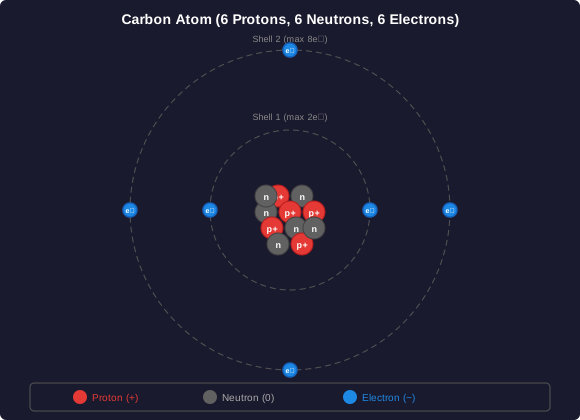
Every atom has three types of particles:
Protons: positively charged, found in the nucleus (center)
Neutrons: no charge, also in the nucleus
Electrons: negatively charged, orbiting the nucleus in an electron cloud
The nucleus is incredibly tiny compared to the whole atom. If an atom were the size of a football stadium, the nucleus would be a marble on the 50-yard line. The electrons would be gnats buzzing around the upper seats.
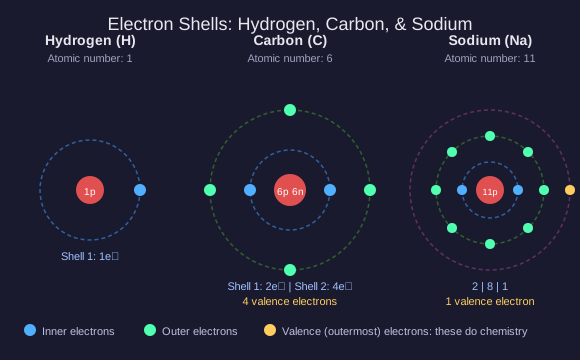
Here is the key fact: the number of protons defines which element an atom is. This number is called the atomic number.
Every atom of hydrogen has exactly 1 proton. Every atom of carbon has exactly 6. Every atom of gold has exactly 79.
Change the number of protons & you change the element entirely.
What Makes an Element?
Gold has 79 protons. Iron has 26 protons. They look different, feel different, & behave differently.
But they are both just collections of protons, neutrons, & electrons.
Mendeleev's Map
The Most Powerful Cheat Sheet in Science
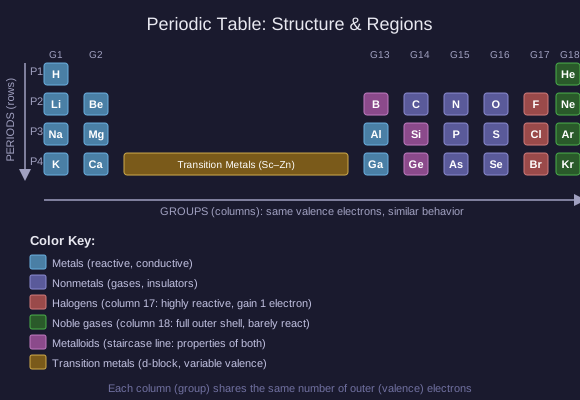
In 1869, a Russian chemist named Dmitri Mendeleev did something brilliant. He wrote the known elements on cards & arranged them by atomic weight.
He noticed that elements with similar properties appeared at regular intervals: a periodic pattern.
He arranged them into a table with rows (periods) & columns (groups).
The genius move: Mendeleev left gaps. He predicted that undiscovered elements would fill those gaps: and he was right. Gallium and germanium were found years later, matching his predictions almost perfectly.
Periods (rows): Each row represents a new electron shell being filled.
Groups (columns): Elements in the same column have the same number of outer electrons: and that is why they behave similarly.
The table divides roughly into metals (left and center: shiny, conductive, malleable), nonmetals (upper right: gases, brittle solids), and metalloids (along the staircase line: properties of both).
And then there are the noble gases in the far right column: helium, neon, argon. They have full outer electron shells, so they almost never react with anything. They are the loners of the periodic table.
Patterns in the Table
Lithium, sodium, & potassium are all in column 1 of the periodic table. All three are soft metals that react violently with water.
Fluorine, chlorine, & bromine are all in column 17. All three are highly reactive nonmetals that love to grab electrons from other atoms.
How Atoms Connect
Why Atoms Bond
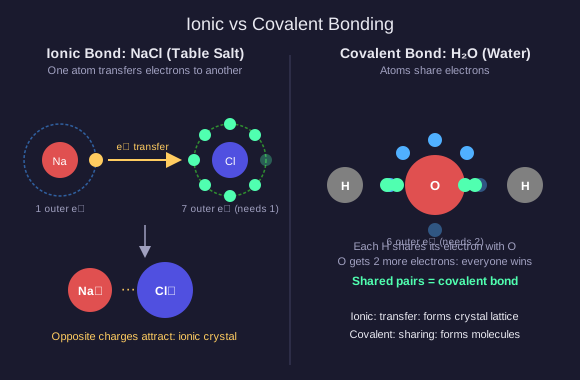
Most atoms are not stable on their own. They want a full outer electron shell: like the noble gases have.
To get there, atoms bond with other atoms in two main ways:
Ionic bonds: one atom transfers electrons to another.
Table salt (NaCl) is the classic example. Sodium has 1 outer electron it wants to lose. Chlorine has 7 outer electrons and wants 1 more. Sodium hands its electron to chlorine. Now both have full outer shells: but sodium is positively charged (lost an electron) and chlorine is negatively charged (gained one). Opposite charges attract, and they lock together.
Covalent bonds: atoms share electrons.
Water (H₂O) works this way. Oxygen needs 2 more electrons. Each hydrogen has 1 to share. So oxygen shares electrons with two hydrogens. Nobody gives up anything: they cooperate.
Ionic compounds tend to form crystals and dissolve in water. Covalent compounds tend to form molecules: individual units like H₂O or CO₂.
Why Salt Dissolves
When you drop a crystal of salt into a glass of water, it disappears. The solid breaks apart & the sodium & chlorine ions spread through the water.
This happens because water is a polar molecule: the oxygen end is slightly negative and the hydrogen ends are slightly positive.
What Is a Reaction?
Reactants Become Products
A chemical reaction happens when atoms rearrange their bonds to form new substances.
The starting materials are called reactants. The results are called products.
One absolute rule: atoms are never created or destroyed in a chemical reaction. This is the law of conservation of mass. Every atom that goes in must come out: just rearranged.
Reactions can be exothermic (release energy: fire, explosions, hand warmers) or endothermic (absorb energy: cold packs, photosynthesis, cooking an egg).
Chemistry is everywhere:
- Rust: iron + oxygen → iron oxide. Slow, exothermic.
- Combustion: fuel + oxygen → carbon dioxide + water. Fast, very exothermic.
- Photosynthesis: carbon dioxide + water + sunlight → glucose + oxygen. Endothermic: the plant stores the sun's energy in chemical bonds.
Every one of these is just atoms breaking old bonds & forming new ones.
Chemistry of Rust
You have probably seen rust on old cars, tools, or nails. Rust forms slowly, but it is a genuine chemical reaction.
The chemical equation is: 4Fe + 3O₂ → 2Fe₂O₃
That reads: four iron atoms react with three oxygen molecules to produce two units of iron oxide (rust).
Chemistry in Your Life
You Are Living Inside a Chemistry Lab
Chemistry is not just something that happens in beakers. It is happening all around you, all the time.
Cooking: When you brown meat or toast bread, that is the Maillard reaction: amino acids and sugars rearranging into hundreds of new flavor compounds.
Medicine: Every drug is a molecule designed to fit into a specific receptor in your body, like a key in a lock.
Materials: The screen you are reading this on exists because chemists figured out how to make liquid crystals, semiconductors, & polymer films.
Batteries: Your phone runs on lithium-ion chemistry: lithium atoms shuttling electrons back and forth between electrodes.
Your body: Right now, enzymes in your cells are catalyzing thousands of chemical reactions per second: breaking down food, building proteins, copying DNA.
Every material, every medicine, every technology traces back to atoms forming bonds.
Your Turn
Connect Chemistry to Your World
You now know about atoms, elements, bonds, & reactions. You have the vocabulary to describe what things come from & why they behave the way they do.