Welcome
Close your eyes for a moment & picture this.
You are standing on the bank of a river so wide you can barely see the other side. The air is hot and dry: over 40 degrees Celsius: and the desert stretches endlessly behind you in every direction. Nothing grows out there. Nothing survives.
But right here, along the river, everything is green. Palm trees sway overhead. Fields of wheat & barley ripple in the breeze. Fishermen cast nets from reed boats. Children splash in the shallows while water buffalo wade nearby.
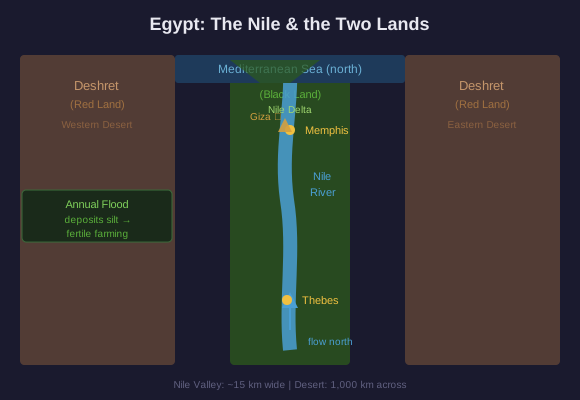
This is the Nile Valley, roughly 3000 BCE. And this thin ribbon of green: never more than a few miles wide, pressed between two vast deserts: is about to become one of the most extraordinary civilizations the world has ever seen.
Over the next 3,000 years, the people here will invent paper, create a 365-day calendar, perform brain surgery, & build monuments so massive they will still be standing in your lifetime.
Let's find out how.
What Do You Know?
Before we dive in, let's see what you already know: or think you know: about ancient Egypt.
A River Like No Other
The River That Built a Civilization
The ancient Greek historian Herodotus visited Egypt around 450 BCE & wrote a famous line: Egypt is the gift of the Nile.
He was not exaggerating. Without the Nile, there would be no Egypt: just empty desert from horizon to horizon.
Here is what made the Nile extraordinary:
The Annual Flood. Every summer, monsoon rains in the mountains of East Africa swelled the Nile until it overflowed its banks. The floodwaters spread across the valley floor, and when they receded weeks later, they left behind a thick layer of dark, incredibly fertile mud called silt. Egyptians called their country Kemet: "the black land": because of this rich, dark soil. The desert beyond was Deshret: "the red land."
Free Fertilizer, Every Year. Farmers did not need to rotate crops or let fields rest. The Nile renewed the soil automatically. This meant Egypt could grow enormous amounts of food: enough to feed not just farmers, but thousands of priests, scribes, soldiers, and builders.
A Highway Through the Desert. The Nile flows north, but the wind in Egypt blows south. So boats could float downstream with the current & sail upstream with the wind. Egypt had a two-way highway 1,000 kilometers long, for free.
Building Material. Papyrus reeds grew thick along the banks. Egyptians wove them into boats, mats, baskets, sandals, and: most importantly: sheets of paper. The word "paper" comes from "papyrus."
A World of Roles
Who Were the Ancient Egyptians?
All that food from the Nile created something revolutionary: spare time. When you do not need every single person farming just to survive, some people can do other things: and that is how civilization grows.
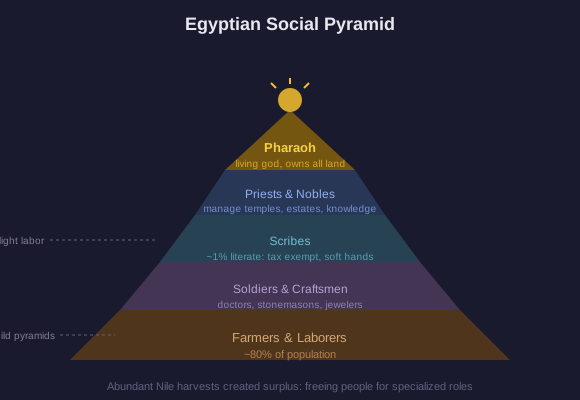
Egyptian society looked like a pyramid (fitting, right?):
Pharaoh: at the very top. Not just a king, but a living god. The pharaoh owned all the land, commanded the army, and was believed to control the Nile flood itself. When a pharaoh sneezed, courtiers said prayers.
Priests and Nobles: they managed the temples and estates. Temples were not just places of worship; they were banks, hospitals, schools, and grain warehouses all in one.
Scribes: the most powerful people you have never heard of. Only about 1% of Egyptians could read and write. If you were a scribe, you never had to do manual labor, you never paid taxes, and you could rise to advise the pharaoh himself. One ancient text tells students: Be a scribe: your limbs will be sleek, your hands will be soft, and you will go forth in white clothes.
Soldiers and Skilled Workers: carpenters, jewelers, stonemasons, doctors. Egyptian doctors were famous across the ancient world. They could set broken bones, stitch wounds, and had over 700 recipes for medicines.
Farmers: about 80% of the population. They worked the fields during planting and harvest seasons, and during the flood months (when farming was impossible), many were recruited for building projects: including the pyramids.
The Power of Writing
Hieroglyphics: Sacred Carvings
The word "hieroglyphic" comes from Greek words meaning sacred carvings: and the Egyptians would have agreed. They believed writing was a gift from Thoth, the ibis-headed god of wisdom.
Egyptian writing used over 700 different symbols. Some represented sounds (like our alphabet), some represented whole words, and some were "determinatives": silent symbols placed at the end of a word to tell you what category it belonged to. A picture of walking legs after a word meant it involved movement. A picture of a seated man meant it was about a person.
Scribes spent 12 years in training: starting around age 5 and finishing around age 17. They learned by copying texts onto ostraca (broken pieces of pottery) because papyrus was too expensive to waste on practice. One teacher wrote to a lazy student: I am told you have abandoned writing and taken to pleasures. You go from street to street, reeking of beer. Beer destroys your soul.
The Rosetta Stone
After Egypt fell to Rome, knowledge of hieroglyphics gradually disappeared. For over 1,400 years, nobody on Earth could read them. Ancient Egypt was a locked book.
Then, in 1799, French soldiers in the town of Rosetta (Rashid) found a stone slab with the same text carved in three scripts: hieroglyphics, a simpler Egyptian script called Demotic, & ancient Greek. Since scholars could read Greek, they finally had a key.
It still took over 20 years. A French scholar named Jean-François Champollion cracked the code in 1822. He reportedly shouted Je tiens l'affaire!: "I've got it!": and then fainted from excitement.
Thanks to Champollion, we can now read thousands of Egyptian texts: love poems, medical guides, court records, prayers, student homework, even complaint letters. The ancient Egyptians became people again, not just monuments.
The Great Pyramid
Engineering the Impossible
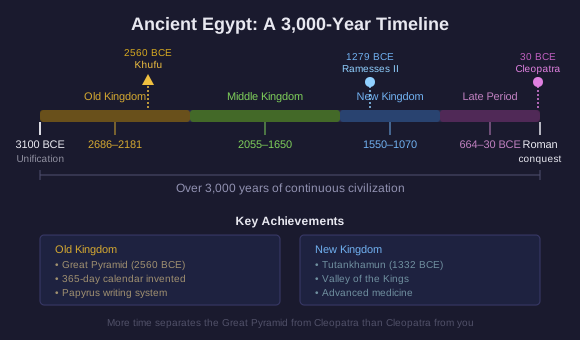
The Great Pyramid of Giza was built around 2560 BCE for Pharaoh Khufu. For nearly 4,000 years, it was the tallest structure on Earth: nothing surpassed it until Lincoln Cathedral's spire was completed in England around 1311 CE.
Here are the numbers, & they are staggering:
- 2.3 million stone blocks, each averaging 2.5 tons (some weigh 80 tons)
- 146 meters tall: about the height of a 48-story building
- 230 meters on each side: so precisely measured that the four sides differ by less than 5 centimeters
- Built in roughly 20 years
- The base is level to within 2 centimeters across its entire area: more precise than most modern buildings
Not Built by Slaves
For centuries, people assumed the pyramids were built by slaves: Hollywood certainly loved that story. But modern archaeology tells a different tale.
In the 1990s, archaeologists discovered the workers' village near Giza. They found bakeries that produced thousands of loaves daily, breweries, a hospital with evidence of healed broken bones (meaning workers received medical care), and graves with the workers buried facing the pyramids: an honor reserved for respected people, not slaves.
The builders were organized, paid, & fed. Many were farmers working during the Nile flood season when they could not farm. Evidence from records shows they worked in teams with competitive names like "Friends of Khufu" & "Drunkards of Menkaure." They took pride in their work.
Building a pyramid was not punishment. It was a national project: part engineering feat, part religious duty, part community identity.
What Egypt Gave Us
5,000 Years Later
Ancient Egypt lasted for over 3,000 years: from roughly 3100 BCE to 30 BCE, when Rome conquered it. To put that in perspective: more time separates the building of the Great Pyramid from Cleopatra than separates Cleopatra from you.
Cleopatra lived closer in time to the Moon landing than to the construction of the Great Pyramid. Let that sink in.
Here is what ancient Egypt gave to the world:
The 365-day calendar. Egyptians noticed that the star Sirius rose just before sunrise once a year, right before the Nile flood. They used this to create a calendar with 12 months of 30 days, plus 5 extra days at the end. We still use their basic structure.
Paper. Papyrus sheets were the world's first portable, flexible writing surface. The word "paper" descends directly from "papyrus."
Medicine. The Edwin Smith Papyrus (about 1600 BCE) describes 48 surgical cases with rational, scientific treatments: no magic spells, just observation and procedure. It includes the first known descriptions of the brain, and instructions for treating spinal injuries.
Architecture & engineering. Techniques for cutting, moving, & precisely fitting massive stone blocks influenced builders for millennia.
Toothpaste. Yes, really. A 4th-century Egyptian recipe includes rock salt, mint, dried iris flower, & pepper. Dentists who tested it said it was surprisingly effective.
The ancient Egyptians were not a mysterious, alien civilization. They were people: clever, ambitious, creative, sometimes lazy, sometimes brilliant: who figured out how to turn a river and a desert into a world that lasted three millennia.